| ID |
Date |
Author |
Type |
Category |
Subject |
|
600
|
Fri Jun 27 15:38:22 2025 |
Christina | Update | TCS | FROSTI Reconstruction |
[Tyler, Ma, Christina, Luke]
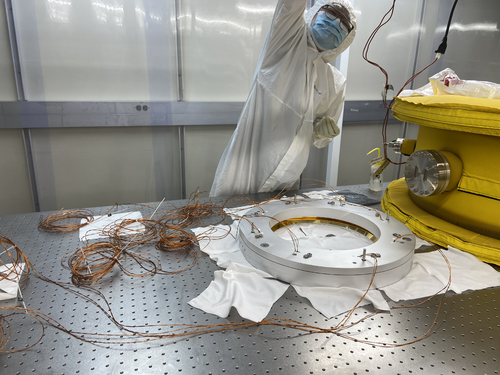
We threaded the wiring of the heater elements through the reflective surfaces and were able to attach each piece with the Macor spacers and connect both sides. We used the guide rails and screws to ensure proper alignment. The only necessary step left is to add the additional external screws for the reconstruction. |
| Attachment 1: IMG_4009.png
|
|
|
599
|
Wed Jun 25 15:44:47 2025 |
Luke | Update | Cleanroom | Cleanroom cleaning |
[Luke, Luis, Tyler, Ma, Christina, Maple]
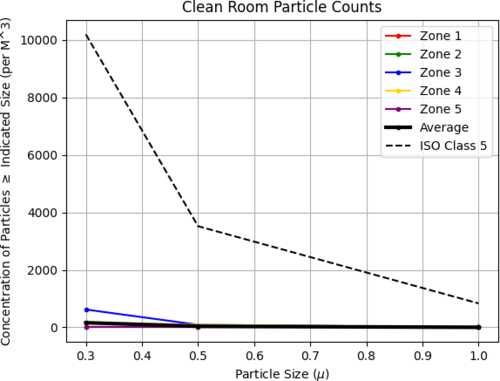
We started by cleaning outside of the cleanroom wiping down the cable channel and working our way down. We replaced the air filter in the HEPA filter with what seemed to be the last one in storage. We then vacuumed outside, before wiping down the inside of the cleanroom. We then vacuumed, mopped, and wiped down the floor inside the cleanroom.
We are ready for venting the vacuum chamber which is planned to take place 6/26/25 at 10am.
Particle Count Measurements:
- Pre-cleaning (12:00 pm):
- Zone 3:
- 0.3 µm: 2517
- 0.5 µm: 662
- 1.0 µm: 176
- Zone 4:
- 0.3 µm: 177
- 0.5 µm: 44
- 1.0 µm: 0
- Post-cleaning (1:45 pm):
- Zone 3:
- 0.3 µm: 619
- 0.5 µm: 88
- 1.0 µm: 0
- Zone 4:
- 0.3 µm: 177
- 0.5 µm: 88
- 1.0 µm: 0
|
| Attachment 1: parttical_count_6-25-25.png
|
|
|
598
|
Tue Jun 24 13:47:58 2025 |
Liu | Update | Interferometer Simulations | Alternative FROSTI A# optimization approach |
| Alternative FROSTI A# optimization approach |
| Attachment 1: Update.pdf
|

|
|
597
|
Tue Jun 24 12:45:16 2025 |
Tyler | Update | General | Updated ADC spectra |
| [Tyler]
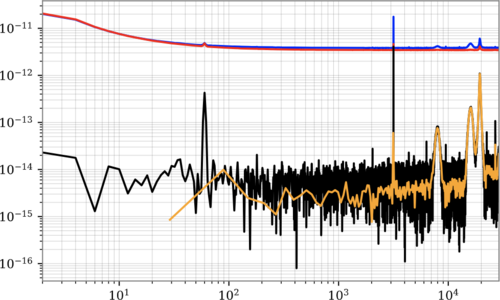
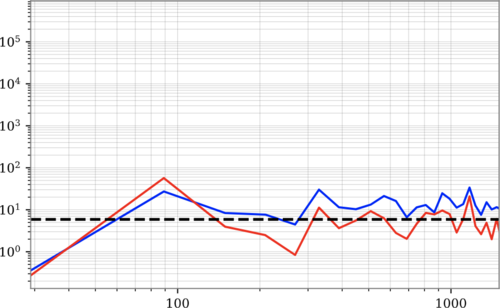
Updated ADC noise spectra measurements using diaggui.
NOTE: Will update plots with proper axes |
| Attachment 1: csd_spec.png
|
|
| Attachment 2: chi_sq.png
|
|
|
596
|
Tue Jun 24 11:50:15 2025 |
Xuesi Ma | Update | | |
Heater Element Resistance Test Results
Heater Element Resistance Test Report
Test Overview
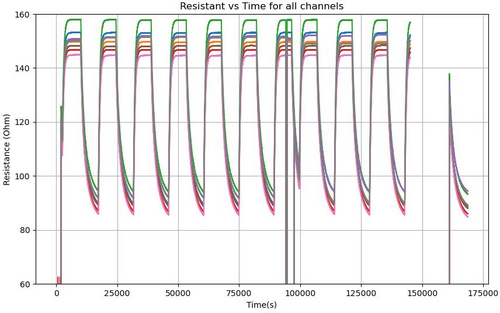
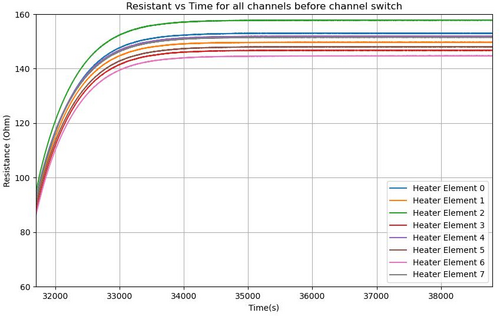
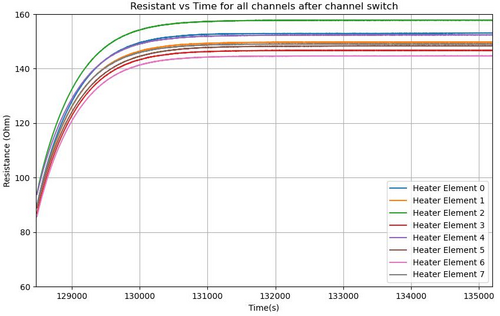
Conducted several on-and-off tests on heater elements at 24V, followed by switching heater elements 5 and 8 by changing their connection pins to the ADC.
Resistance Measurements (Ω)
| Heater Element |
Before Switch |
After Switch |
Ladder Test |
Difference (After-Before) |
| Element 1 |
153.09577918 |
153.11447008 |
153.83373894 |
+0.0186909 |
| Element 2 |
149.70967557 |
149.8175605 |
150.08915205 |
+0.10788493 |
| Element 3 |
157.88314236 |
157.87136021 |
157.39696467 |
-0.01178215 |
| Element 4 |
146.80153622 |
146.78826747 |
147.77923177 |
-0.01326875 |
| Element 5 |
151.80888657 |
152.2204132 |
150.44919044 |
+0.41152663 |
| Element 6 |
148.24375881 |
148.32846152 |
146.89161192 |
+0.08470271 |
| Element 7 |
144.72286546 |
144.76879963 |
145.03627875 |
+0.04593417 |
| Element 8 |
151.4564267 |
149.14240417 |
149.88675562 |
-2.31402253 |
Supporting Graphs
Attached below are the resistance-time graphs for all heater elements:
- Complete test duration graph
- Pre-switch period graph
- Post-switch period graph
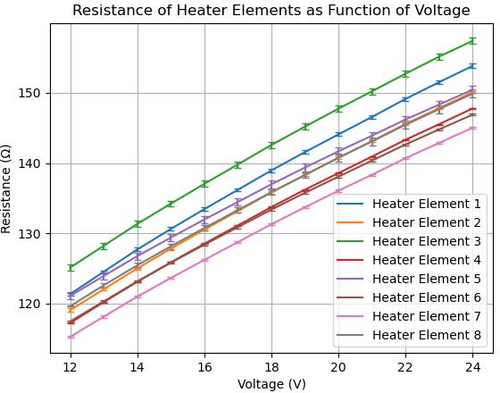
- Resistance voltage graph after removing data from after power outage
Analysis & Conclusion
The switch did not physically change the resistance of the heater elements, suggesting the measurements reflect their true resistances.
|
| Attachment 1: resistance_vs_time_all_channels_channel_switch.jpg
|
|
| Attachment 2: resistance_vs_time_all_channels_channel_switch_one_cycle_before.jpg
|
|
| Attachment 3: resistance_vs_time_all_channels_channel_switch_one_cycle_after.jpg
|
|
| Attachment 4: resistance_vs_voltage.jpg
|
|
|
595
|
Tue Jun 17 12:46:47 2025 |
Tyler | Update | Electronics | CyMAC ADC Noise |
| Below are results from power spectra measurements of the CyMAC ADC, computed form 30 hours of time series data, compared to the performance of the Red Pitaya. The frequency resolution for the initial Cymac CSD is 2 Hz, and 216,000 spectra measurements are averaged together. As of now, it still looks like we haven't reached the correlated noise floor of the CyMAC. We have a few days worth of data to take from, so I'll look into using a longer period of time. |
| Attachment 1: cymac_v_rp_csds.pdf
|

|
| Attachment 2: chi_sq_cymac_v_rp.pdf
|

|
|
594
|
Tue Jun 17 12:22:43 2025 |
Xuesi Ma | Update | | |
CYMAC Remote Control Cable Documentation
CYMAC Remote Control Cable Assembly
Cable Functions
The custom cable assembly serves two primary functions:
1. Jumper Connections (DB25 Side - Connector J3)
The following pins are jumpered on the DB25 connector:
| From Pin |
To Pin |
| Pin 3 |
Pin 16 |
| Pin 10 |
Pin 11 |
| Pin 12 |
Pin 24 |
| Pin 13 |
Pin 25 |
| Pin 22 |
Pin 23 |
2. Signal Wiring (DB9 to DB25)
The following connections are made between the DB9 and DB25 connectors:
| DB9 Pin |
DB25 Pin |
Function |
| Pin 1 |
Pin 9 |
Positive side |
| Pin 6 |
Pin 12 |
Negative side |
| Pin 5 |
Pin 6 |
Ground |
Note: All connections are verified with a multimeter.
Note: This cable allows remote control of the Sorensen power supply with an external voltage source (Cymac DAC).
Note: For more details, check section 2.11.1 from the attached Sorensen power supply manual.
|