| ID |
Date |
Author |
Type |
Category |
Subject |
|
660
|
Thu Nov 13 12:39:01 2025 |
Mary | Update | Interferometer Simulations | |
|
| Attachment 1: PA.pdf
|

|
|
663
|
Thu Nov 20 13:03:58 2025 |
Cece Ochoa | Update | ELOG | CE Cavity Design Update |
| Update on grouping 0+8th Order Modes |
| Attachment 1: 11_20_update.pdf
|

|
|
664
|
Thu Nov 20 13:54:34 2025 |
Tyler | Update | TCS | FROSTI A# Optimization and Mesh Convergence Analysis |
| Attached below are slides discussing FROSTI A# Irradiance optimization and mesh convergence analysis for penetration depth. |
| Attachment 1: Updates_11_19_2025-3.pdf
|

|
|
665
|
Thu Dec 4 12:10:19 2025 |
Tyler | Update | TCS | FROSTI A# Profiles and Element Width Optimization |
| Slides |
|
666
|
Thu Dec 18 12:51:13 2025 |
Tyler | Update | TCS | FROSTI A# Profiles Update |
| Slides |
|
667
|
Thu Jan 8 12:51:03 2026 |
Tyler | Update | TCS | FROSTI A# Update 01/08/2026 |
| Slides |
|
668
|
Thu Jan 15 12:52:58 2026 |
Tyler | Update | TCS | A# FROSTI Profiles 01/15/26 |
| Slides |
|
669
|
Thu Jan 15 13:52:55 2026 |
Xuesi Ma | Update | TCS | FROSTI A# Reflector Update |
| Slides |
|
671
|
Thu Jan 22 13:12:29 2026 |
Mary | Update | | |
|
| Attachment 1: PA_matem2.pdf
|

|
| Attachment 2: PA_maxtem6.pdf
|

|
| Attachment 3: maxtem600.jpg
|
|
| Attachment 4: maxtem2dis.jpg
|
|
| Attachment 5: dismaxtem6.jpg
|
|
|
673
|
Thu Jan 22 14:06:00 2026 |
Xuesi Ma | Update | TCS | FROSTI A# Reflector Update |
| Slides |
|
674
|
Wed Jan 28 11:29:30 2026 |
Tyler | Update | TCS | A# FROSTI Profiles 01/15/26 |
A# Profile optimization update for 01/28/2026 group meeting.
Slides |
|
675
|
Thu Jan 29 12:46:22 2026 |
Cece Ochoa | Update | | CE Cavity Design Update (4) |
| Update for CE Cavity Arms + Modes
https://docs.google.com/presentation/d/1-dXYylkAbNpHR4WVCx9Q8ryL_xGlH-JSSLXEUQg6b7Q/edit?usp=sharing |
|
678
|
Thu Feb 5 13:12:28 2026 |
Tyler | Update | TCS | A# FROSTI Profiles 01/15/26 |
Slides updating progress on FROSTI A# irradiance profiles and reflector design. Edge roll-off is now included for thermoelastic deformation corrections.
| Quote: |
A# Profile optimization update for 01/28/2026 group meeting.
Slides |
|
|
679
|
Thu Feb 5 13:34:13 2026 |
Cynthia | Update | Interferometer Simulations | Point absorber + miscentering simulation |
|
| Attachment 1: update2_5_(3).pdf
|
.png "update2_5_(3).pdf")
|
|
680
|
Thu Feb 5 13:49:31 2026 |
Michael | Update | Interferometer Simulations | Updating Squeezing Mode Matching Logic |
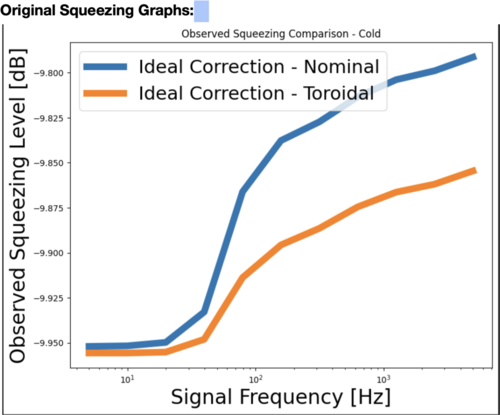
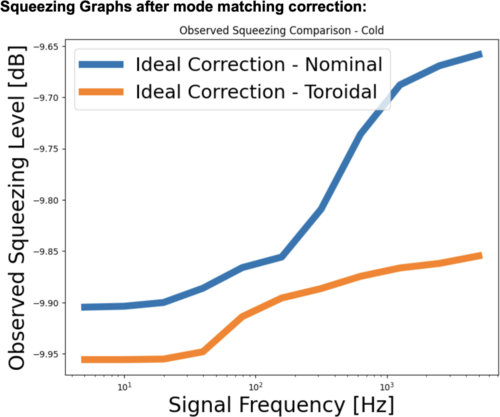
| After some tests, I have determined that the squeezer in the aLIGO katscript is currently being matched to the SRC. This logic will cause issues if the SRC mode is perturbed and no longer closely matched to arm modes. Currently, my modification to the code involves taking the arm mode incident at the ITM and propagate the beam parameter using the ABCD matrix from the ITM to the injected squeezing port. Rerunning some of the squeezing simulations for a cold interferometer, it appears the toroidal case remains the same but the nominal mirror case degrades. Is this expected when we match to the arm instead of the SRC? |
| Attachment 1: screenshot2.png
|
|
| Attachment 2: screenshot1.png
|
|
|
681
|
Thu Feb 5 13:59:42 2026 |
Mary | Update | Interferometer Simulations | |
|
| Attachment 1: 112.pdf
|

|
|
683
|
Thu Feb 12 12:53:51 2026 |
Cece Ochoa | Update | ELOG | CE Cavity Design Update |
| Update on HOM placement w/ cavity locking. Still verifying mode placement
RoC: 28340m and 26874m |
| Attachment 1: 2_12_short_update.pdf
|

|
|
684
|
Thu Feb 12 12:59:29 2026 |
Mary | Update | | |
|
| Attachment 1: SB_scattering.pdf
|

|
|
685
|
Thu Feb 12 13:50:38 2026 |
Xuesi Ma | Update | VAC | Vacuum status warning system |
Vacuum Pressure Warning Script
Script Location: controls@chimay
Script Path: /vac/python/serial/temp_vacuum_warning.py
Purpose
Implement an automated warning system that monitors vacuum pressure and sends
email alerts when pressure thresholds are exceeded.
Implementation Details
-
The script runs
launcher.py (located in the same directory)
every 30 minutes to retrieve the latest vacuum pressure reading.
-
If the pressure rises above the critical threshold
(≥ 1 × 10⁻⁶ Torr), an email alert will be sent
to all group members.
-
If the pressure rises above the warning threshold
(≥ 1 × 10⁻⁷ Torr), an email alert will be sent
to Xuesi Ma.
-
If
launcher.py fails to retrieve the vacuum pressure,
or if any execution error occurs, an error notification email
will be sent to Xuesi Ma.
How to Run
python temp_vacuum_warning.py
Note
An app password is required for authentication in order to send alert emails.
|
|
686
|
Thu Feb 19 12:34:18 2026 |
Cynthia | Update | Interferometer Simulations | Point absorber simulation |
|
| Attachment 1: update_2_18.pdf
|

|
|
687
|
Thu Feb 19 12:59:47 2026 |
Tyler | Update | TCS | A# FROSTI Profiles 01/15/26 |
Slides covering a new approach to optimizing for A# FROSTI profiles. In particular, we start looking at just optimal RH correction. Once this profile is determined, we then minimize the residual further with FROSTI profiles.
| Quote: |
Slides updating progress on FROSTI A# irradiance profiles and reflector design. Edge roll-off is now included for thermoelastic deformation corrections.
| Quote: |
A# Profile optimization update for 01/28/2026 group meeting.
Slides |
|
|
|
688
|
Thu Feb 26 20:25:10 2026 |
Cynthia Liang | Update | Interferometer Simulations | Point Absorber+Miscentering Simulation |
|
| Attachment 1: update_2_18_Merged.pdf
|

|
|
690
|
Thu Mar 5 13:01:14 2026 |
Tyler | Update | TCS | A# FROSTI Profiles Optimization |
Slides discussing updates on FROSTI A# profile optimizations. In particular, a new RMS function is defined which reduces inner-radii wavefront error variation to a greater degree.
| Quote: |
Slides covering a new approach to optimizing for A# FROSTI profiles. In particular, we start looking at just optimal RH correction. Once this profile is determined, we then minimize the residual further with FROSTI profiles.
| Quote: |
Slides updating progress on FROSTI A# irradiance profiles and reflector design. Edge roll-off is now included for thermoelastic deformation corrections.
| Quote: |
A# Profile optimization update for 01/28/2026 group meeting.
Slides |
|
|
|
|
692
|
Thu Mar 12 12:48:58 2026 |
Cynthia | Update | Interferometer Simulations | New Result of point absorber+miscentering |
|
| Attachment 1: Untitled_presentation_(1).pdf
|
.png "Untitled_presentation_(1).pdf")
|
|
Draft
|
Thu Mar 12 13:18:49 2026 |
Cece Ochoa | Update | Interferometer Simulations | CE Cavity Design Update |
| Animation showing how modes shift in the CE arm cavity for radius 27581m and mirror radius of40cm as the laser powers up the 1.5 MW.
https://drive.google.com/file/d/1UNvWmONWYDzroelC5j_Z2emGSotyzcCC/view?usp=sharing |
|
694
|
Wed Apr 1 15:02:30 2026 |
Tyler | Update | TCS | A# FROSTI Profiles Optimization 04/02/2026 |
Slides discussing SURF, OPD, and SURF+OPD optimizations for idealized FROSTI A# profiles.
| Quote: |
Slides discussing updates on FROSTI A# profile optimizations. In particular, a new RMS function is defined which reduces inner-radii wavefront error variation to a greater degree.
| Quote: |
Slides covering a new approach to optimizing for A# FROSTI profiles. In particular, we start looking at just optimal RH correction. Once this profile is determined, we then minimize the residual further with FROSTI profiles.
| Quote: |
Slides updating progress on FROSTI A# irradiance profiles and reflector design. Edge roll-off is now included for thermoelastic deformation corrections.
| Quote: |
A# Profile optimization update for 01/28/2026 group meeting.
Slides |
|
|
|
|
|
695
|
Thu Apr 2 12:23:40 2026 |
Michael | Update | Interferometer Simulations | Update Plots and Squeezing Behavior With Toroidal Mirrors |
|
| Attachment 1: Update_4-2-26.pdf
|

|
|
696
|
Thu Apr 9 12:40:24 2026 |
Xuesi Ma | Update | TCS | A# Ring Heater Design |
Slides discussing for A# Ring Heater design.
|
|
697
|
Thu Apr 9 12:50:28 2026 |
Cynthia | Update | Interferometer Simulations | O5 Test mass |
| https://docs.google.com/presentation/d/1vJPZ9H_umgsZacCLgsqAUZWjn7-6l77np3E_YgaSy_M/edit?usp=sharing |
|
698
|
Thu Apr 16 12:53:30 2026 |
Cynthia | Update | Interferometer Simulations | O5 Test mass |
|
| Attachment 1: 4_16_update.pdf
|

|
|
699
|
Thu Apr 16 13:14:42 2026 |
Tyler | Update | TCS | A# FROSTI Profiles Optimization 04/02/2026 |
Slides discussing including overlapped irradiance profiles at the center of an A# ITM.
| Quote: |
Slides discussing SURF, OPD, and SURF+OPD optimizations for idealized FROSTI A# profiles.
| Quote: |
Slides discussing updates on FROSTI A# profile optimizations. In particular, a new RMS function is defined which reduces inner-radii wavefront error variation to a greater degree.
| Quote: |
Slides covering a new approach to optimizing for A# FROSTI profiles. In particular, we start looking at just optimal RH correction. Once this profile is determined, we then minimize the residual further with FROSTI profiles.
| Quote: |
Slides updating progress on FROSTI A# irradiance profiles and reflector design. Edge roll-off is now included for thermoelastic deformation corrections.
| Quote: |
A# Profile optimization update for 01/28/2026 group meeting.
Slides |
|
|
|
|
|
|
700
|
Thu Apr 16 14:04:46 2026 |
Mary | Update | Interferometer Simulations | Beam position optimization algorithm |
|
| Attachment 1: beam_position_optimization.pdf
|

|
|
702
|
Thu Apr 23 11:32:48 2026 |
Cece Ochoa | Update | Interferometer Simulations | CE Cavity Design Update |
| Update on CE Mirror RoC, simulation with FROSTI and cavity locking
View Presentation |
|
703
|
Thu Apr 23 12:47:05 2026 |
Cynthia | Update | Interferometer Simulations | O5 Test mass |
|
| Attachment 1: 4_23_26.pdf
|

|
|
705
|
Thu Apr 30 12:08:02 2026 |
Mary | Update | VAC | New Vacuum design |
| https://autode.sk/3QFUGF8 |
|
706
|
Thu Apr 30 12:52:26 2026 |
Mary | Update | Interferometer Simulations | Full interferometer simulation |
|
| Attachment 1: Full_interferometer.pdf
|

|
|
707
|
Thu Apr 30 13:23:55 2026 |
Cynthia | Update | Interferometer Simulations | O5 Test mass |
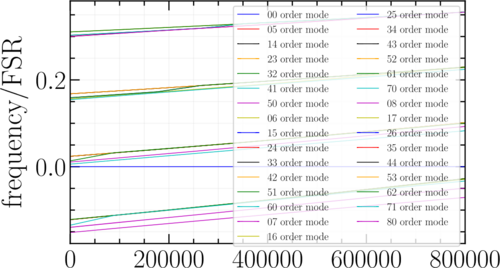
| frequency locations of 5-8th order mode across arm power of 0-800kW |
| Attachment 1: scan_5-8.png
|
|
|
709
|
Tue May 5 12:58:53 2026 |
Tyler | Update | TCS | FROSTI A# Profiles 05/07/2026 Group Meeting |
| Slides detailing the incorporation of minimizing curvature overlap between FROSTI and ring heater actuation profiles. |
|
711
|
Thu May 7 13:35:14 2026 |
Cynthia | Update | Interferometer Simulations | O5 Test mass |
|
| Attachment 1: Screenshot_2026-05-07_133453.png
|
|
|
712
|
Thu May 14 12:37:17 2026 |
Cynthia | Update | Measuring Noise in Interferometer | O5 Test mass design |
|
| Attachment 1: update_5_13.pdf
|

|
|
713
|
Thu May 14 13:42:57 2026 |
Cynthia | Update | Interferometer Simulations | less-roll-off coating |
|
| Attachment 1: e6caa8cf-2a96-49d8-a8b7-b84feab55404.png
|
|
|
714
|
Thu May 28 12:54:38 2026 |
Cynthia | Update | Interferometer Simulations | O5 Test mass |
|
| Attachment 1: 5_28_update_(1).pdf
|
.png "5_28_update_(1).pdf")
|
|
715
|
Thu Jun 4 11:21:29 2026 |
Mary | Update | VAC | Vacuum design |
| https://autode.sk/43S0ZbK |
| Attachment 1: Convection.png
|
|
| Attachment 2: VC_Design_-_06-04-2026.pdf
|

|
|
716
|
Thu Jun 4 13:30:46 2026 |
Cynthia | Update | Interferometer Simulations | O5 Test mass Presentation |
|
| Attachment 1: Nonspherical_polishing_profile_design_recommendation.pdf
|

|
|
719
|
Thu Jun 18 12:36:46 2026 |
Mary | Update | | Beam position optimization algorithm |
| Slides |
|
720
|
Thu Jun 25 11:42:29 2026 |
Mary | Update | TCS | Beam position optimization algorithm |
|
Weight Calibration: this study looks at how the thermal-compensation system should be tuned as the laser beam moves off-center on a detector mirror, with a fixed point-absorber defect in place. The optimizer that sets the actuator powers tries to flatten the wavefront, and it balances two kinds of distortion( i.e. surface distortion against substrate optical-path distortion) by a ratio that had been fixed at 20:1, but that value was only validated for a centered beam. So here I sweeps this ratio across beam positions from 0–5 cm along +x, with and without the absorber, re-optimizing the actuator powers at each position and judging each choice by the resulting power recycling gain from the fully locked interferometer.
Slides |
|
722
|
Thu Jun 25 13:21:31 2026 |
Cece | Update | Inventory | Optics Inventory Update |
| [Shane, Ma, Cece]
Updated optics inventory here.
Changes made: removed thrown out optics from sheet, added new optics found during Ma and Shane's cleaning, updated optics location (now all in 1119 optical cabinets, mostly in labeled yellow bins). |
|
723
|
Thu Jun 25 13:45:11 2026 |
Cynthia | Update | Interferometer Simulations | Poster Draft |
| https://docs.google.com/presentation/d/1tpYjs-gOfZgFFkffU0kv7rYKHu0xtfPyMZqF1qXHIOQ/edit?usp=sharing |
|
724
|
Thu Jul 2 11:09:09 2026 |
Cece Ochoa | Update | Inventory | PPE/Cleaning Supplies Inventory |
| [Shane, Cece]
Shane has made a Google Form to take inventory of PPE and cleaning supplies.
Additionally, she has made a form for purchase order requests.
Please use the first form to take inventory when NEW supplies arrive, and in future cleanings use the form to take inventory so we can have an accurate count of what is in the lab.
I have also made an optics inventory form that will update the previous optics inventory spreadsheet. |
|
725
|
Thu Jul 2 13:26:16 2026 |
Abhiram Sharma | Update | Interferometer Simulations | |
| Update on MCMC SURF project |
| Attachment 1: Week_1.pdf
|

|