| ID |
Date |
Author |
Type |
Category |
Subject |
|
117
|
Thu Jun 8 14:51:58 2023 |
Pamella | Update | FLIR | FLIR- Distance |
[Pamella, Tyler]
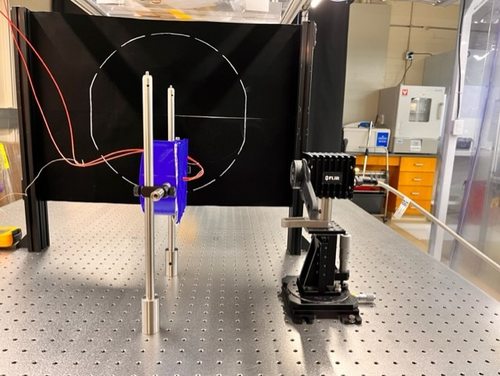
- Today we change the distance between the FLIR camera and reflector (3D-Mask with mirrors and light). Now the distance is 0.2032 m.
- Note: This distance is just for take a snap most close possible but we need move again for a little far way because in this distance we can't move up and down the reflector for have data to compare.
|
| Attachment 1: AcquisitionImage(Jun-08-2023_14_33).jpg
|
.jpg.png "AcquisitionImage(Jun-08-2023_14_33).jpg")
|
| Attachment 2: thumbnail_IMG_7441.jpg
|
|
|
118
|
Mon Jun 12 12:15:10 2023 |
Pamella | Update | FLIR | FLIR- Take data in the closest point. |
[Pamella]
- Used the closest point possible for the reflector in front of the FLIR camera.
- 11:32 am : Turned on the electronic device (current on) for started taking data.
- 11:50 am: Started checking the temperature and the parameters.
- 12:04 pm: Started taking snap after waited for 30 minutes with the current on. Parameters: Current: 0.13A , Volt: 1.8V and Temperature: 51.4 C.
- Note: This snap is in the most close point possible, after that I should be change the reflector position and also the optical focus distance in the FLIR camera.
We can see, in the photo attached below, thought in this closest position the cable connect to reflector is a bit problem to take a good snap also the have issues to keep very uniform triangles (temperature) in the reflector.
- To do: I'll change the position on the light inside to see if the problem it is in the focal point inside the reflector (mirror).
|
| Attachment 1: AcquisitionImage(Jun-12-2023_12_04).jpg
|
.jpg.png "AcquisitionImage(Jun-12-2023_12_04).jpg")
|
|
119
|
Mon Jun 12 18:52:00 2023 |
Pamella | Update | General | Heater system parts - Wiped and bagged |
[Pamella]
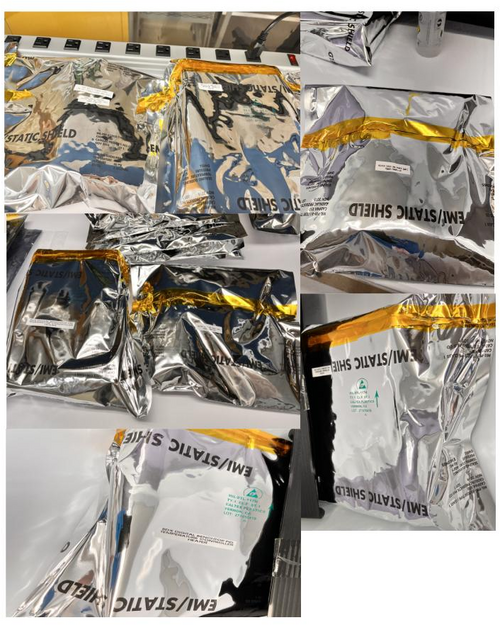
Cleaning the heater system parts.
- 04:32 pm: Started wiping the heater system parts.
- 06:38 pm: Finished wiping the heater and some parts to the system. I wiped, tagged and bagged the heater system, power cables, adapter cables and power connectors. Also I wiped, bagged and tagged the aluminum foil tape.
- 06:43 pm: I putted all bags inside the cleanroom.
- To do: I started but I was not able to finished wiping the heating and cords for the heater system so I will finished this parts after.
- I attached the photos below.
|
| Attachment 1: heater_equipment_wiped.jpg
|
|
|
120
|
Tue Jun 13 10:28:50 2023 |
Pamella | Update | General | Wiped and bagged the heating and cords. |
[Pamella]
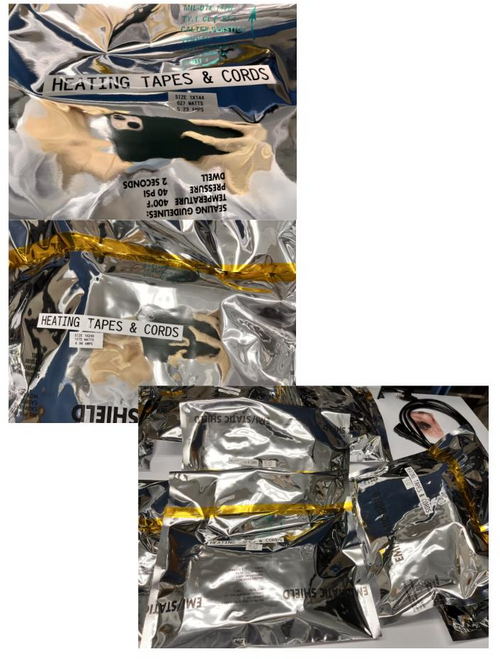
- Cleaning the heater system parts.
- 09:13 am: Started wiping the last parts for the heater system (heating and cords).
- 10:18 am: Finished wiping the parts to the heater system (heating and cords). I wiped, tagged and bagged the heating and cords.
- Note: In some parts looks like the silicone insulation material is having some sort of residue on the wipe so I wiped very careful this part and just for a few minutes.
- 10:23 am: I putted all bags inside the cleanroom.
I attached the photos below. |
| Attachment 1: heater_cords_wiped.jpg
|
|
|
122
|
Tue Jun 13 21:08:46 2023 |
Pamella | Infrastructure | VAC | Heater system - Installation |
[Pamella, Cao and Jon]
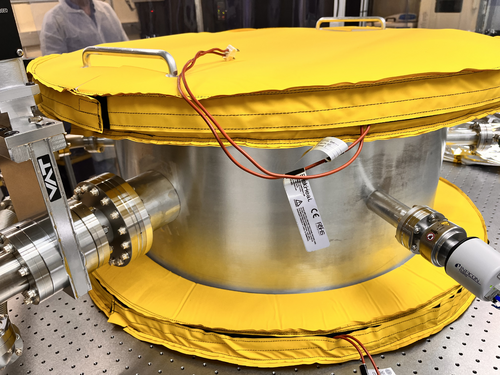
Heating system installation
- Today we started installing the equipments for the heating system.
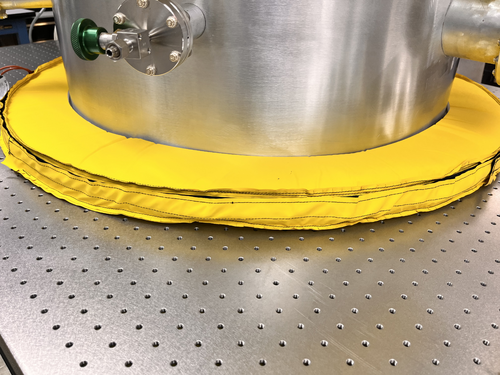
- First: Started installing the heating cable on the top lid and covered it with aluminum tape.
- Second: Started installing the insulation cover on top of the chamber lid.
- Third:Started installing the heating cable from under the vacuum chamber and covered with aluminum tape.
- Forth: Started installing the insulation cover under the vacuum chamber
- Note: The under part of the chamber vacuum was very difficult to cover, so we spent a little time on it and we couldn't finish the whole installation today. So tomorrow we should be able to keep doing the installation.
|
| Attachment 1: IMG_7563.jpeg
|
|
| Attachment 2: IMG_7561.jpeg
|
|
|
123
|
Tue Jun 13 21:33:46 2023 |
Pamella | Update | General | New cabinet for PPI |
[Pamella and Dr.Richardson]
Dr. Richardson installed the new cabinet outside the room for the PPI equipments, and then I wiped all surfaces inside and outside of the new cabinet.
Dr.Richardson and I have finished organizing the PPI within the new cabinet. Also we have new supplies of gloves, and will likely have more supplies for other PPIs soon. |
|
124
|
Wed Jun 14 15:35:36 2023 |
Pamella | Update | VAC | Heating system installation |
[Pamella and Cao]
Heating system installation - Second day.
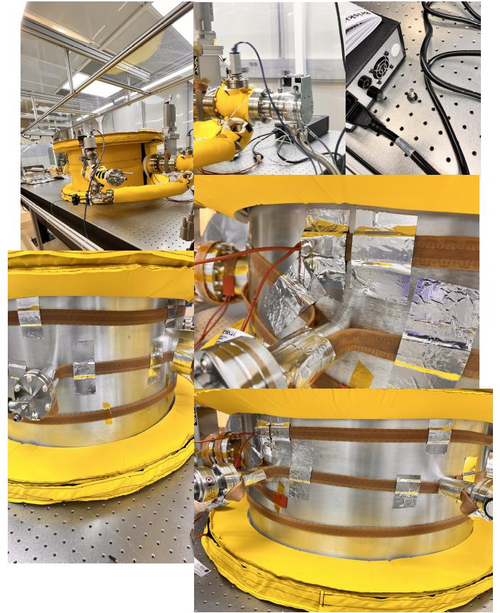
- Today we kept installing the equipment for the heating system.
- First: Started installing the two heating cable around the chamber vacuum, the arms and covered it with aluminum tape.
- Second: Started installing the insulation stuff around the vacuum chamber and around the connections points (the arms) in the vacuum chamber.
- Third:Started installing the heater system (electronic device) and tried testing.
-
Note: The around part of the chamber vacuum was difficult to cover, so we spent a little time on. Also one heater system electronic device wasn't working because one fuse is burned so we could not finished this part and we need wait for a new one to replace and working on it.
|
| Attachment 1: heater_equipment_install.jpg
|
|
|
125
|
Fri Jun 16 16:17:13 2023 |
Pamella | Update | FLIR | FLIR - Change the position |
[Pamella]
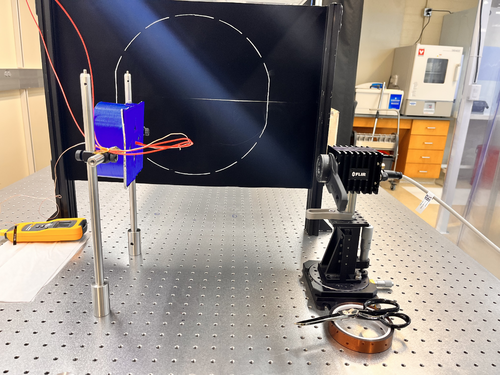
Today I change the distance between the FLIR camera and reflector (3D-Mask with mirrors and light). Now the distance is 0.3282 m.
- Note: In this distance is possible move up and down the reflector and take data to compare.
- The focal point inside the reflector keeping like little problem, every time I tried adjust this I got some triangles is not with "perfect emission" (looks like different than the others). Also if I move up or down the focal point inside the reflector have some issues as well.Therefore I am working on that.
|
| Attachment 1: IMG-7637.jpg
|
|
|
127
|
Mon Jun 19 11:20:57 2023 |
Pamella | Update | FLIR | FLIR - Fixed some problems |
[Pamella]
- 08:59 am: Turned on the electronic device (current on) for started taking data.
- 09:37 am: Tried understanding the error in the focal point. I realized the pillars was in the wrong place and because of that we got problems to keep the reflector in the correct position to FLIR focus.
- 09:58 am: Started checking the temperature and the parameters.Changed the pillars to the original position (0.5645m) just for checking with the problem was the pillar in the wrong place.
- 10:06 am: Changed the reflector to point (0.3282m) and now in the correct position for the pillars. Started take snap and collecting data. I moved up and down the reflector for got data to compare later.
- 10:37 am: Used the closest point possible for the reflector in front of the FLIR camera with the correct spot for the pillars.(0.2032m)
- 11:00 am: Started taking snap after kept the current on for a few hours. Parameters: Current: 0.10A , Volt: 1.3V and Temperature: 41.9 C.
- I attached below the snap in the most close point possible, now i can see a better photo and I think a fixed the problem about the focal point in the reflector for have more uniformity between the triangles, isn't perfect yet but now is just some adjustments. Furthermore after that I should be change the reflector position and also the optical focus distance in the FLIR camera and try use the black wall.
|
| Attachment 1: AcquisitionImage(Jun-19-2023_11_00).jpg
|
.jpg.png "AcquisitionImage(Jun-19-2023_11_00).jpg")
|
|
128
|
Tue Jun 20 17:28:23 2023 |
Pamella | Update | Electronics | Heater system parts - Wiped |
[Pamella]
Wiping the heater system parts.
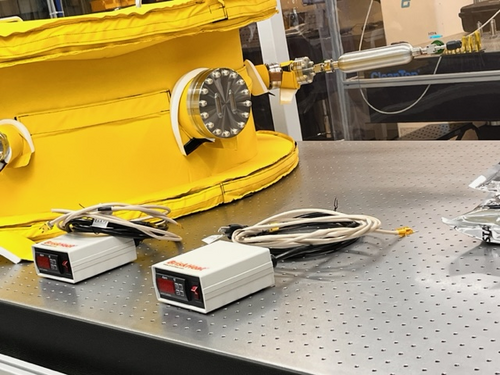
- 04:37 pm: Started wiping the electronic device part for the heater system (HL101 Series Digital Benchtop temperature limit control).
- 05:19 pm: Finished wiping the parts to the heater system (HL101 Series Digital Benchtop temperature limit control). I wiped the HL101 Series Digital Benchtop temperature limit control and I didn't bagged and tagged because we should install that soon.
- 05:23 pm: I putted heater electronic device inside the cleanroom without the bag. Also the electronic device is near to the vacuum chamber and the other parts to heater system.
- I attached the photo below.
|
| Attachment 1: IMG_7696.jpg
|
|
|
132
|
Fri Jun 23 15:47:06 2023 |
Pamella | Update | FLIR | Collecting data - Moving horizontal and vertical on screen. |
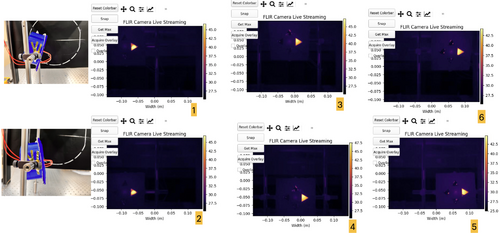
[Pamella]
- 02:09 pm: Turned on the device (current on)
- 02:42 pm: Started taking snap on position one (Reference point: 0,-0.062). Parameters:0.10A,1.5V,41.5C
- I took multiplier snap on the same position for compare after on data analyzes. I just wanted one/two minute break between the snaps. I did that same for every position.
- 02:55 pm: Started taking snap on position two (Reference point:-0.10,-0.062 ). Parameters: 0.10A,1.5v,43 C
- 03:01 pm: Started taking snap on position three (Reference point:0.05 ,-0.062). Parameters: 0.1A,1.4V,42.8C
- 03:07 pm: Started taking snap on position four (Reference point: 0.05,0.045). Parameters:0.10A,1.5V,43.6 C
- 03:15 pm: Started taking snap on position five (Reference point: 0,0.045). Parameters:0.10A, 1.4V, 44.1C
- 03:22 pm: Started taking snap on position six (Reference point: 0,0.045). Parameters: 0.10A,1.4V,43.3 C
- We can see in the photos attached below than have some differences between every position so I should be starting analyzes on that.
|
| Attachment 1: AcquisitionImage(Jun-23-2023_14_42).jpg
|
.jpg.png "AcquisitionImage(Jun-23-2023_14_42).jpg")
|
| Attachment 2: AcquisitionImage(Jun-23-2023_14_57).jpg
|
.jpg.png "AcquisitionImage(Jun-23-2023_14_57).jpg")
|
| Attachment 3: AcquisitionImage(Jun-23-2023_15_01).jpg
|
.jpg.png "AcquisitionImage(Jun-23-2023_15_01).jpg")
|
| Attachment 4: AcquisitionImage(Jun-23-2023_15_07)_(3).jpg
|
_(3).jpg.png "AcquisitionImage(Jun-23-2023_15_07)_(3).jpg")
|
| Attachment 5: AcquisitionImage(Jun-23-2023_15_15).jpg
|
.jpg.png "AcquisitionImage(Jun-23-2023_15_15).jpg")
|
| Attachment 6: AcquisitionImage(Jun-23-2023_15_22).jpg
|
.jpg.png "AcquisitionImage(Jun-23-2023_15_22).jpg")
|
|
135
|
Tue Jun 27 15:18:26 2023 |
Pamella | Update | FLIR | New data collection |
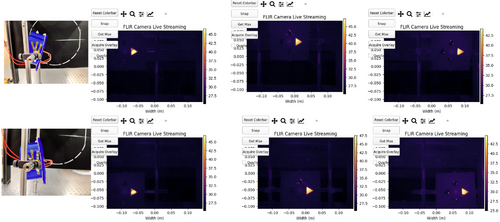
Yesterday, I did a new data collection. I could get a better data in this time and I realized than I need use some angle on the reflector for got a better shot. I need do that because the FLIR camera just is able to get the triangle shape for complete if I keep exactly in same line for center point on the camera but for the data now I need move the refletor to go up and go down. So wasn't working very well if I keep the reflector without angle.
Now I am using the refletor with a angle. In the more high part I turn the mask for look the table and in the lower part I turn the mask to look up. I attached a photo below for this configuration.
Also the processes to get the data was the same than I using last time, the only diference is now I just moved the pillar after get data for high position and lower position for the same reference point on the triangle shape.
Note: In most data it is impossible to keep the same parameter for current, voltage and temperature. Most have a small variation but not a big difference. For example: I got the temperature in the first position 46.8 °C and in the second position I got 47.1 °C, it's just an example. It's just so we know that we don't have the exact same parameters all the time. In my opinion this is not a problem because it is just a small variation.
- 09:35 am: Turned on the device (current on). I wanted for 30 minutes before start get data.
- 10:05 am: Started taking snap on position one (Reference point: -0.10, 0.050). Parameters:0.11A,1.7V,46.8°C
- I took four snap on the same position for compare after on data analyzes. I just wanted one minute break between the snaps. I did the same for every position.
- 10:15 am: Started taking snap on position two (Reference point:-0.10,-0.050 ). Parameters: 0.11A,1.7V,47.1° C
- 10:22 am: Started taking snap on position three (Reference point:0.00 ,0.050). Parameters: 0.11A,1.6V,48.1°C
- 10:26 am: Started taking snap on position four (Reference point: 0.00,-0.050). Parameters:0.11A,1.6V,48 °C
- 10:32 am: Started taking snap on position five (Reference point: 0.05,-0.050). Parameters:0.11A, 1.6V, 48°C
- 10:37 am: Started taking snap on position six (Reference point: 0.05,0.050). Parameters: 0.11A,1.7V,47.6 °C
- We can see in the photos attached below every position also I am working in the analyzes.
|
| Attachment 1: FLIR_data.002.jpeg
|
|
| Attachment 2: FLIR_data_2.002.jpeg
|
|
|
139
|
Fri Jun 30 15:57:28 2023 |
Pamella | Update | FLIR | Data and python code update |
Updates: Problems with the emission intensity and python code.
- Yesterday I was working on get data from FLIR reflector but unfortunately we got some problems:
- I realized than if I move the reflector a to left or right the screen doesn't get data very well(I attached a photo below). This is a problem because our idea is have the same type of emission every part on screen. Tyler and I worked to tried fix that but don't had success.
- Dr. Richardson gave me the idea to move the FLIR camera to left or right (The same happens if I move up and down) and keep the refletor on the same position every time but unfortunately we got the same problem, the screen doesn't get data very well(I attached a photo below). Now I am working to tried fix that.
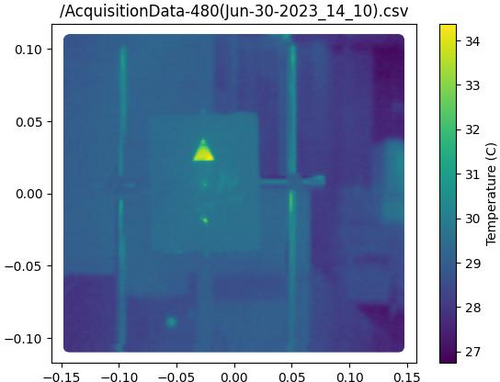
- Also I was able to work on the code to isolate the triangle shape for analyzes, I attached the image for that below.
|
| Attachment 1: isolation1-2.jpg
|
|
| Attachment 2: AcquisitionImage(Jun-29-2023_18_27)_(1).jpg
|
_(1).jpg.png "AcquisitionImage(Jun-29-2023_18_27)_(1).jpg")
|
| Attachment 3: AcquisitionImage(Jun-29-2023_18_38).jpg
|
.jpg.png "AcquisitionImage(Jun-29-2023_18_38).jpg")
|
| Attachment 4: AcquisitionImage(Jun-29-2023_18_39).jpg
|
.jpg.png "AcquisitionImage(Jun-29-2023_18_39).jpg")
|
|
140
|
Fri Jun 30 16:43:14 2023 |
Pamella | Update | FLIR | Updates: Small moving the FLIR camera |
[Pamella]
Today, I was able to make some adjustments to the FLIR camera angle, suggested by Dr. Richardson, and we got small possible movements keeping the same pattern in the shapes of the triangles. I have attached photos below. I was able to move left and right as well as up and down and it worked in four points that I marked on the table.
The only problem is that it only worked on a part of the screen, if I try to place it farther to the right or to the left, we are back to the same problem as yesterday.
|
| Attachment 1: AcquisitionImage(Jun-30-2023_16_23)_(3).jpg
|
_(3).jpg.png "AcquisitionImage(Jun-30-2023_16_23)_(3).jpg")
|
| Attachment 2: AcquisitionImage(Jun-30-2023_16_23)_(1)(1).jpg
|
_(1)(1).jpg.png "AcquisitionImage(Jun-30-2023_16_23)_(1)(1).jpg")
|
| Attachment 3: AcquisitionImage(Jun-30-2023_16_24).jpg
|
.jpg.png "AcquisitionImage(Jun-30-2023_16_24).jpg")
|
| Attachment 4: AcquisitionImage(Jun-30-2023_16_22)_(1)(1).jpg
|
_(1)(1).jpg.png "AcquisitionImage(Jun-30-2023_16_22)_(1)(1).jpg")
|
| Attachment 5: AcquisitionImage(Jun-30-2023_16_22)_(1).jpg
|
_(1).jpg.png "AcquisitionImage(Jun-30-2023_16_22)_(1).jpg")
|
|
143
|
Mon Jul 3 18:38:13 2023 |
Pamella | Update | FLIR | FLIR project |
[Pamella]
- I was able to work on the python code to do analysis on the FLIR-Reflector data.
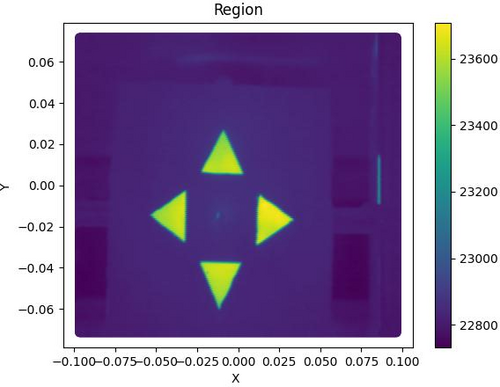
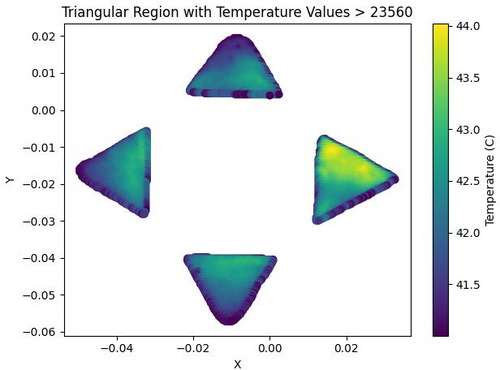
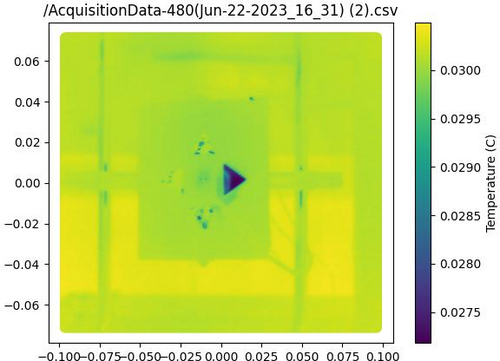
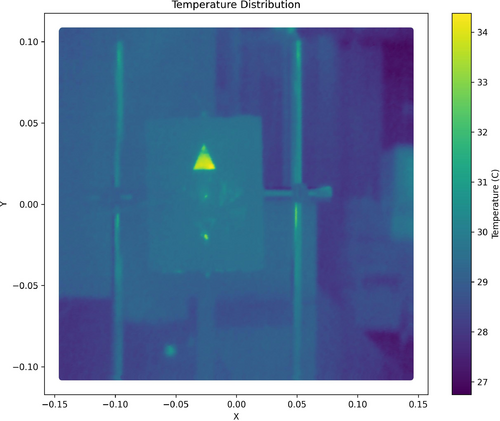
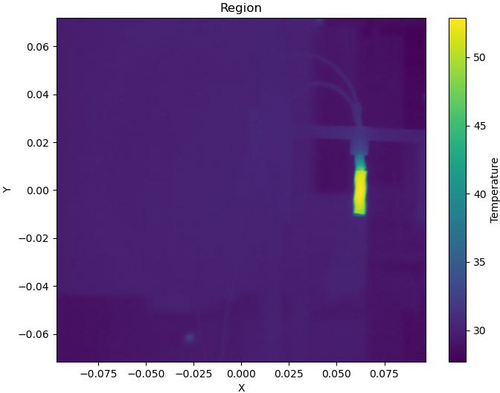
- I could plot images of total area (Tyler help me on that) with csv file and also could have isolation area for triangles. I have attached examples below. Just for now the images are of different data, so there are some differences in the shapes.
- I'm working on getting a complete analysis code to work with the different positions of the triangles and to be able to do out the statistical analysis.
- Also we keeping have problem to get good data if when we move the camera or the reflector on horizontal or vertical position. I am working a some ideas for that.
|
| Attachment 1: Region.jpg
|
|
| Attachment 2: triangular_region_temperature-2.jpg
|
|
| Attachment 3: heatmap.jpg
|
|
| Attachment 4: isolation1-4.jpg
|
|
|
144
|
Tue Jul 4 15:35:38 2023 |
Pamella | Update | FLIR | FLIR - reflexion problem |
| [Pamella]
I was testing all the positions we need to cover when moving the FLIR camera or the reflector. I tried to find out more about the problem so I tested the position without the mask, just with the old bridge and I got the same problems, in the middle of the screen we have a very good image but if we move we have the visualization problem and we don't see the reflection very well (intensity, emissivity) in FLIR.
For this test I used very low current (0.04 A) for keep everything safety.
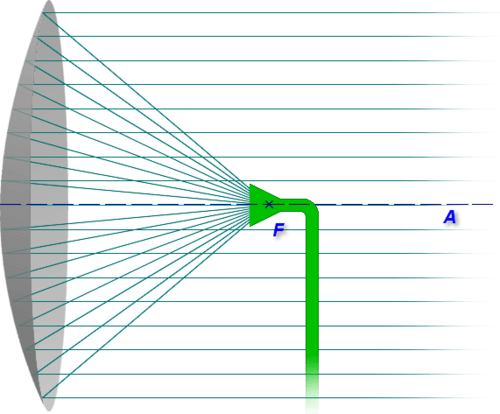
I also think that problem is not in the focal point of the reflector because we can see very well in the center of the screen, but maybe it is because in the parabolic reflector the reflection in the focal point is "extremely" straight, so for you to see the reflection in this point you need keep close to the middle of the screen, to see around the reflector, at the extremes, we need to change the position for the cable or the light to "change" how the flashes of light reflect and thus achieve exactly the position on the camera. It is something like the sketch/ photo attached below. |
| Attachment 1: AcquisitionImage(Jul-03-2023_14_29).jpg
|
.jpg.png "AcquisitionImage(Jul-03-2023_14_29).jpg")
|
| Attachment 2: AcquisitionImage(Jul-03-2023_14_31).jpg
|
.jpg.png "AcquisitionImage(Jul-03-2023_14_31).jpg")
|
| Attachment 3: AcquisitionImage(Jul-03-2023_14_49).jpg
|
.jpg.png "AcquisitionImage(Jul-03-2023_14_49).jpg")
|
| Attachment 4: Caderno_sem_título_(26)-2.jpg
|
-2.jpg.png "Caderno_sem_título_(26)-2.jpg")
|
| Attachment 5: parabol1.print.png
|
|
|
149
|
Thu Jul 6 18:03:19 2023 |
Pamella | Update | FLIR | FLIR project - New configuration |
[Pamella]
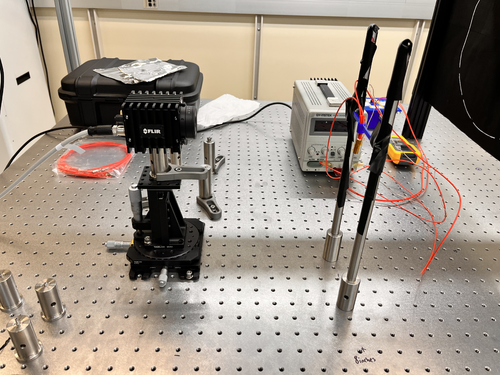
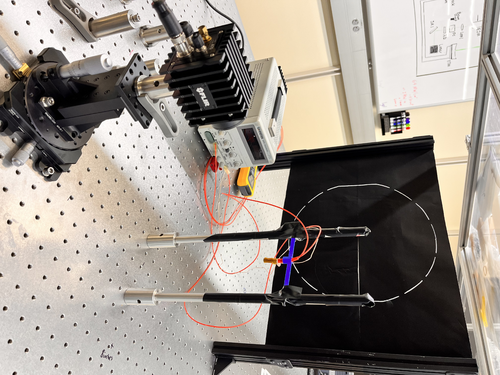
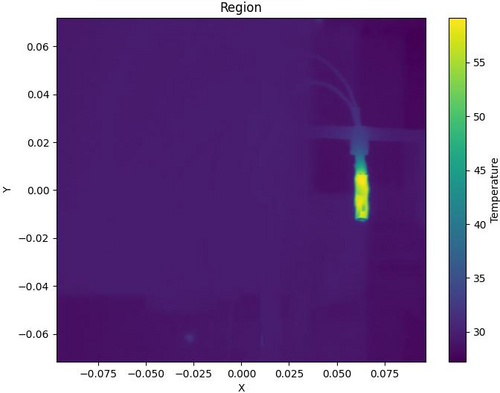
Cao suggested using the project without the reflector and mask because in this case we probably got good images around the screen. So I started this yesterday and today I started to get some data to see the stabilization position and check how the parameters fluctuated. I was looking and taking snaps for an hour and a half. I'll repeat this one more time to make sure we have enough data to do analysis.
To do: The next step is to start collecting data by moving the camera FLIR and covering all six positions on the screen (2x3). Also Aiden is on hand to help and is going to make a new 3D print bridge to have good heater support.
I attached a image for the new configuration below and a snap data. |
| Attachment 1: IMG_8193.jpeg
|
|
| Attachment 2: IMG_8183.jpeg
|
|
| Attachment 3: AcquisitionImage(Jul-06-2023_17_18)_(1).jpg
|
_(1).jpg.png "AcquisitionImage(Jul-06-2023_17_18)_(1).jpg")
|
| Attachment 4: region_temperature1.jpg
|
|
|
151
|
Sat Jul 8 14:26:17 2023 |
Pamella | Update | FLIR | Data with the new configuration without the mask and reflector. |
| [Pamella]
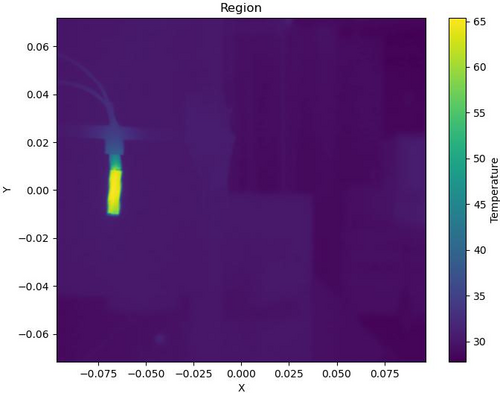
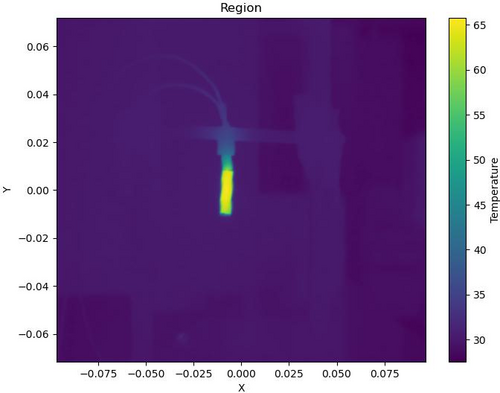
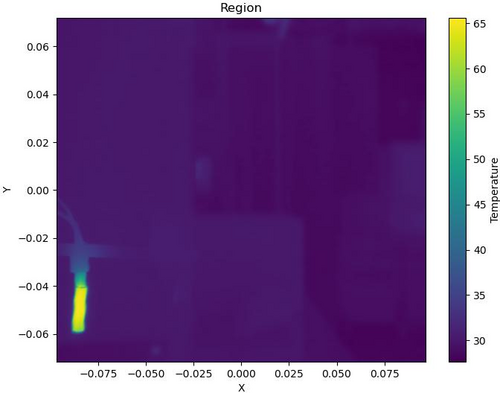
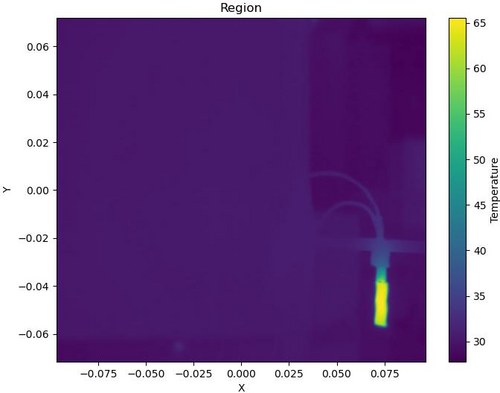
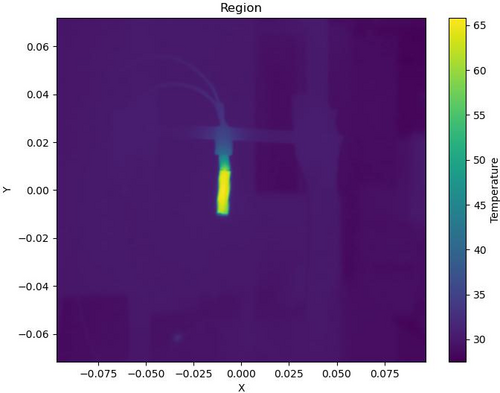
I started collecting data by moving the camera FLIR and covering all six positions on the screen (2x3). I was looking and taking snaps for more than one hour and a half. I'll repeat this one more time to make sure we have enough data to do analysis.
I attached snap data below. This images is processed on python code. |
| Attachment 1: region2-3.jpg
|
|
| Attachment 2: region3-2.jpg
|
|
| Attachment 3: region4.jpg
|
|
| Attachment 4: region5.jpg
|
|
| Attachment 5: region6.jpg
|
|
| Attachment 6: region_temperature1-2.jpg
|
|
|
157
|
Fri Jul 14 16:49:42 2023 |
Pamella | Update | FLIR | New bridge and calibration data |
[Pamella]
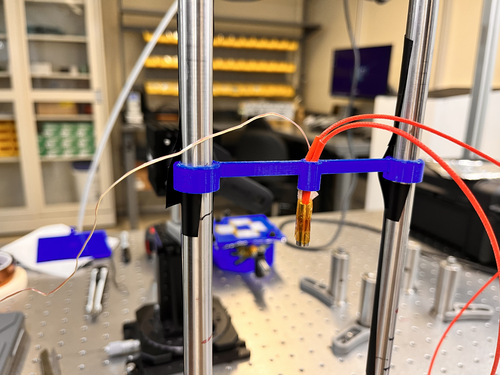
Aiden 3D printed a new bridge for the heater and I installed the new bridge yesterday.
I started collecting data to plot a calibration with the heater. I'm doing measurements with current and the thermocouple (thermometer) to compare with FLIR measurements and have a good calibration. |
| Attachment 1: IMG_8606.jpeg
|
|
|
158
|
Sun Jul 16 15:21:56 2023 |
Pamella | Update | General | General update about some problems in the lab. |
[Pamella]
General information about the lab facility.
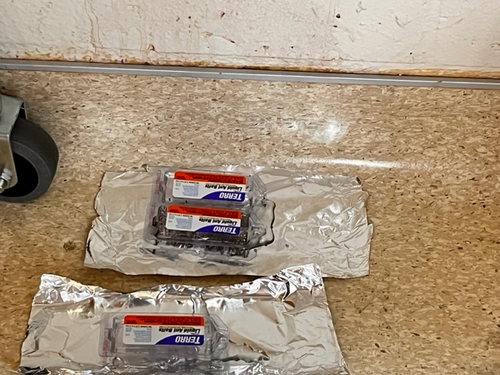
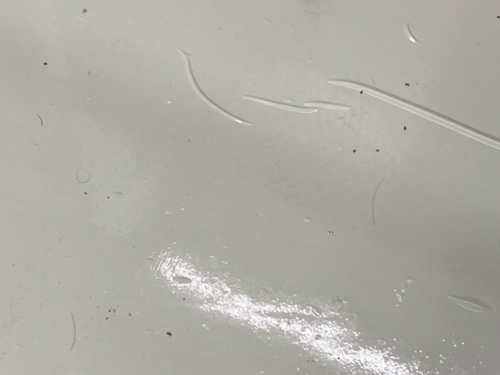
- Changed sticky floor mats, because close to entrance the cleanroom, both sticky floor had a many died ants on top.
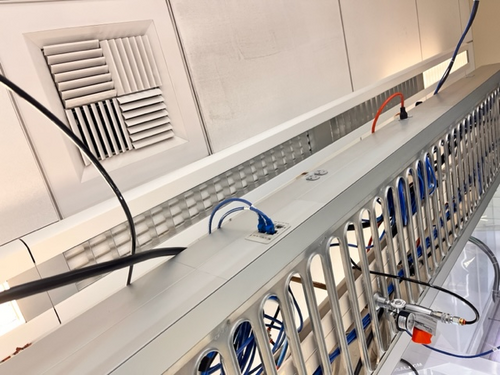
- The light on top of the internet cable bridge is burned out.. I just saw this today but I am not sure if was like this before.
- The ant bait traps seem very efficient and right now only a few ants are running around in the lab, most are dead in the bait traps, so probably in a day or two we can change those bait traps.
|
| Attachment 1: IMG_8637.jpg
|
|
| Attachment 2: IMG_8633.jpg
|
|
| Attachment 3: IMG_8631.jpg
|
|
|
159
|
Mon Jul 17 11:46:24 2023 |
Pamella | Update | FLIR | Thermocouple plot. |
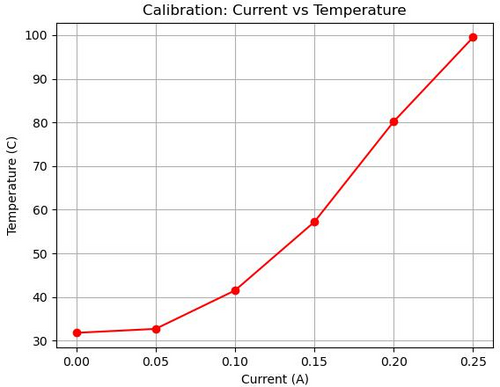
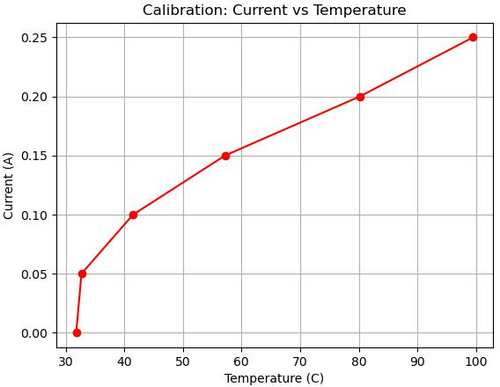
[Pamella]
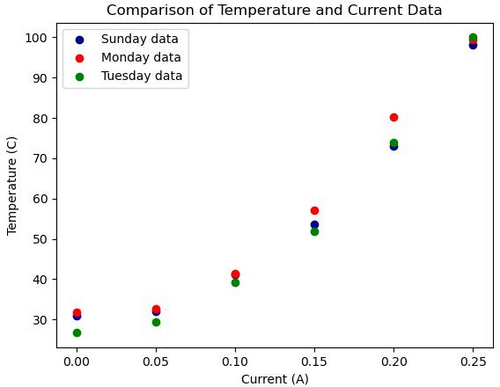
- I collected data to plot a calibration with the heater. I took measurements with current and temperature (the thermocouple - thermometer) to compare with the FLIR measurements.
- I made a plot with this data and we can see how temperature vs current behaves.
Note: This data I measured manually.
|
| Attachment 1: calibration_plot-2.jpeg
|
|
| Attachment 2: calibration_plot-3.jpeg
|
|
|
163
|
Tue Jul 18 16:04:26 2023 |
Pamella | Update | FLIR | Setup FLIR with black wall (black body) |
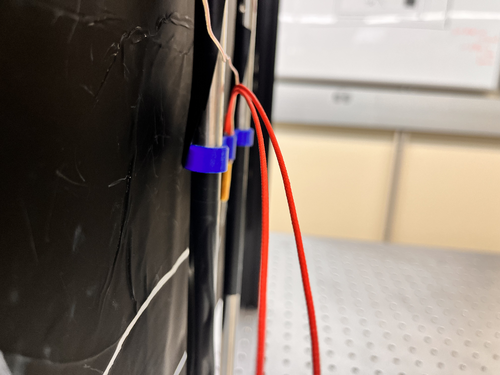
[Pamella]
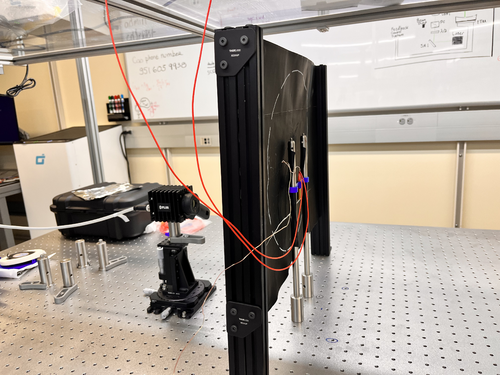
- Today I tried get data the heater with the black screen but doesn't looks possible have just one "energy" point straight to FLIR camera. Tyler and I tried different current and temperatures but keep very bad data. I attached a snap below.
- I attached a photo about the new setup below. The FLIR is in the most close point possible/safety with the heater. The heater is very close to the black wall but is not touch the screen so is safety.
|
| Attachment 1: AcquisitionImage(Jul-18-2023_15_24).jpg
|
.jpg.png "AcquisitionImage(Jul-18-2023_15_24).jpg")
|
| Attachment 2: IMG_8721.jpeg
|
|
| Attachment 3: IMG_8722.jpeg
|
|
|
164
|
Tue Jul 18 16:12:27 2023 |
Pamella | Update | FLIR | Thermocouple plot. |
- I noticed that these measurements have some issues with the weather on different days. We can see in the photo attached below how different the temperatures are on different days, I took the data with the same procedure every day, but we can see the differences between them.
- To Do: I will do a new data collection using FLIR and thermocouple at the same time to plot comparison between both.
| Quote: |
[Pamella]
- I collected data to plot a calibration with the heater. I took measurements with current and temperature (the thermocouple - thermometer) to compare with the FLIR measurements.
- I made a plot with this data and we can see how temperature vs current behaves.
Note: This data I measured manually.
|
|
| Attachment 1: Comp.plot.jpeg
|
|
|
165
|
Tue Jul 18 16:35:06 2023 |
Pamella | Update | FLIR | Plot-Data with the new configuration without the mask and reflector. |
[Pamella]
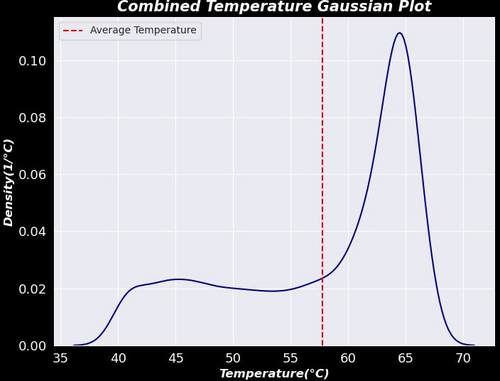
- I was able to plot the first graph for a result between the six different positions on the screen, for now we can see the behavior of the heater temperature in a Gaussian graph with combination data between the six files.
- To do: Tyler gave me some ideas today to improve the plot. So I'm going to change the code to have insulation on the values for just the heater ("insulation") and I'm going to plot after this insulation data as well I'm going to get more data and compare with more data for the same position.
- I was using the data than I got last week and I shared on Elog (151) and we can see on this quote
| Quote: |
| [Pamella]
I started collecting data by moving the camera FLIR and covering all six positions on the screen (2x3). I was looking and taking snaps for more than one hour and a half. I'll repeat this one more time to make sure we have enough data to do analysis.
I attached snap data below. This images is processed on python code. |
|
| Attachment 1: Gauss.plot.jpeg
|
|
|
167
|
Wed Jul 19 19:10:31 2023 |
Pamella | Update | FLIR | Data plot FLIR and updates. |
[Pamella]
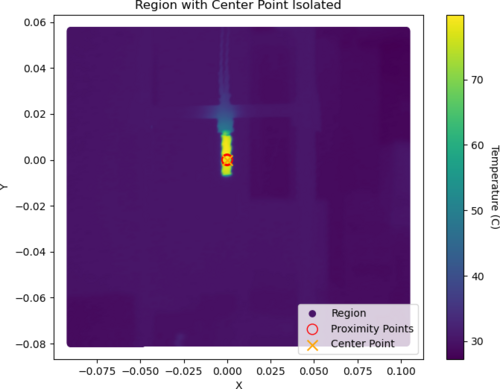
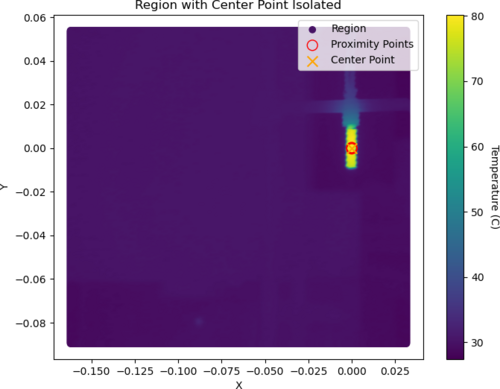
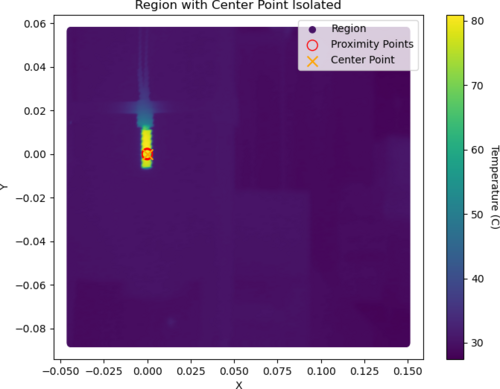
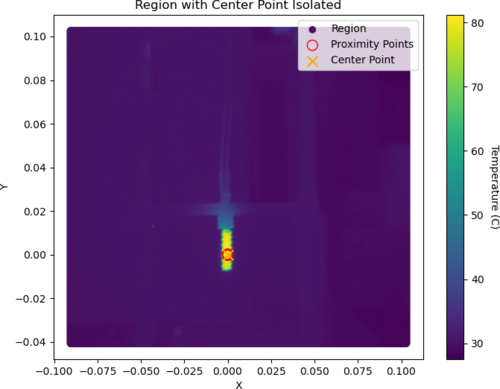
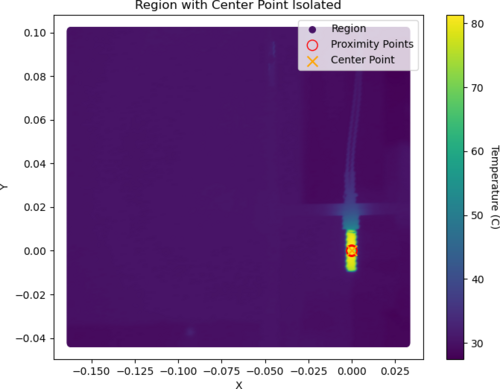
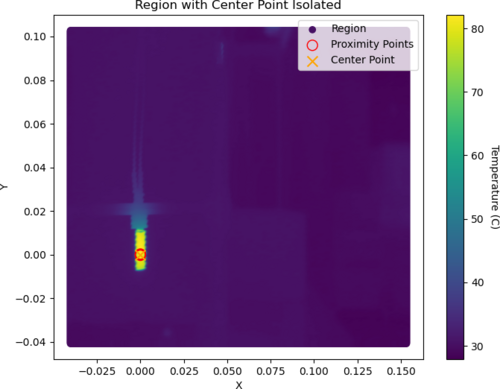
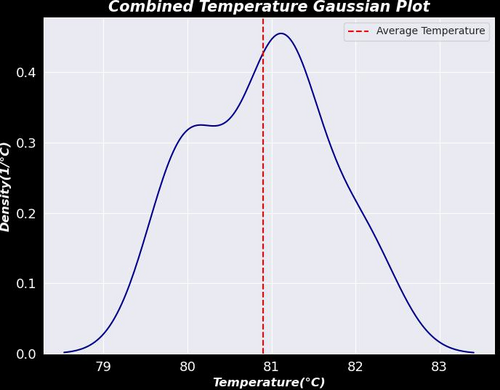
- Today I was able to plot a graph for the isolation point on the center of the heater. I got data from six different positions on the screen (I shifted the all coordinates). I extracted the data for the center point and plot the Gaussian with this extracted data for temperature. I attached the all plots below
- Also I took a snap using the black wall and with the heater at 120.1 C (0.30 A) try to have less noise but
we can see this is not very good. At this temperature, we have noise on the top and I don't understand why because the heater is not in this location. I attached a snap below.
|
| Attachment 1: 1_Isolated_Plot.png
|
|
| Attachment 2: 2_Isolated_Plot.png
|
|
| Attachment 3: 3_Isolated_Plot.png
|
|
| Attachment 4: 4_Isolated_Plot.png
|
|
| Attachment 5: 5_Isolated_Plot.png
|
|
| Attachment 6: 6_Isolated_Plot.png
|
|
| Attachment 7: Gauss.plot-2.jpeg
|
|
| Attachment 8: AcquisitionImage(Jul-19-2023_17_01).jpg
|
.jpg.png "AcquisitionImage(Jul-19-2023_17_01).jpg")
|
|
169
|
Thu Jul 20 21:00:23 2023 |
Pamella | Update | FLIR | Data plot FLIR and updates about the black body |
[Pamella]
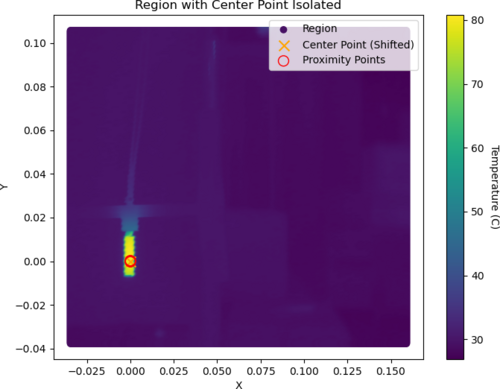
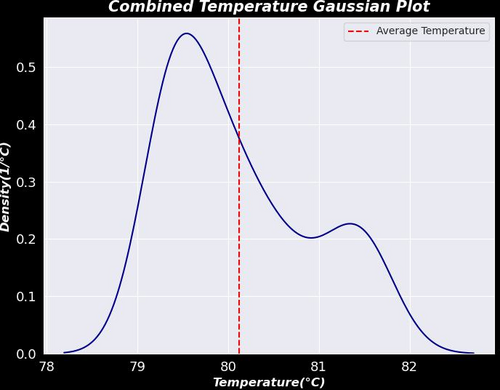
- Today I got more data to plot the Gaussian. So I took more snaps in each position for the six different spots than we be using to have a better calibration of the FLIR collected data. I attached the new plot below. Also, I did the same plot for each region as on the Elog 167 but I have more than 20 pics because I was using a big number of data so I just attached one example below.
To access the Elog, click here.
- Also I think we have some real (non-ideal) heat diffusion by the screen and not noise like Dr. Richardson suggested. I was testing today and we can see the first pic before the start heater source turns on, the second pic is at 120.2 C (0.31A) with the heater on and the last pic is after the heater source cooled back down to room temperature. Just in the second pic, we have a strong spot on the top, so it looks like a non-ideal diffusion.
|
| Attachment 1: AcquisitionImage(Jul-20-2023_13_09).jpg
|
.jpg.png "AcquisitionImage(Jul-20-2023_13_09).jpg")
|
| Attachment 2: AcquisitionImage(Jul-20-2023_13_15).jpg
|
.jpg.png "AcquisitionImage(Jul-20-2023_13_15).jpg")
|
| Attachment 3: AcquisitionImage(Jul-20-2023_13_33).jpg
|
.jpg.png "AcquisitionImage(Jul-20-2023_13_33).jpg")
|
| Attachment 4: AcquisitionData-480(Jul-20-2023_SIsolated_Plot.png
|
|
| Attachment 5: Gauss.plot-2.jpeg
|
|
|
181
|
Fri Jul 28 18:03:07 2023 |
Pamella | Update | FLIR | Final plot - FLIR |
[Pamella]
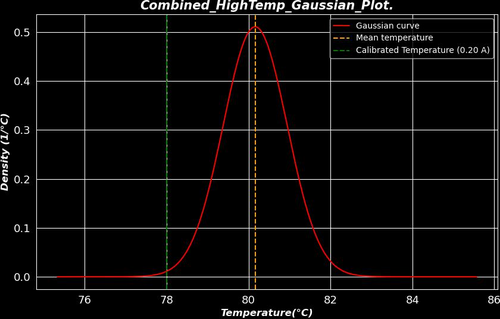
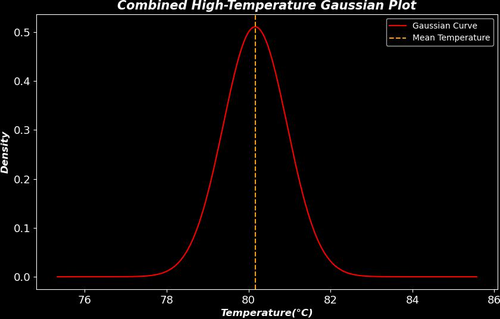
- I was able to plot the final result with the data to the heater. I attached below the "3Combined_HighTemp_Gaussian_Plot." in this plot we can see better behavior on the Gaussian compared to the plot in ELOG 169, I was using the same data but with a different approach. On the ELOG 169, we have the center point isolated data and this new plot is the temperature more than 70 C isolated because we have a very good heater temperature distinguish do background. For the all data I got I was using a power current of 0.20A. To get the data I waited for 30 minutes until the heater became stable and after that, I started to take snaps, I took more than one snap for each one different 6 positions on the screen, and We can see the positions on ELOG 167.
- Also I attached the calibration plot ("calibration_plot") between the measurements with the FLIR camera and thermocouple and we can see looks good if we compare the final plot.
- For better analyses I attached a plot of the calibration line on the Gaussian plot.
- To do: I will finish the final report.
|
| Attachment 1: 29Combined_HighTemp_Gaussian_Plot.jpg
|
|
| Attachment 2: 3Combined_HighTemp_Gaussian_Plot.jpg
|
|
| Attachment 3: calibration_plot(2).png
|
.png.png "calibration_plot(2).png")
|
|
536
|
Mon Mar 10 21:13:12 2025 |
Nathan | Update | VLC Update | PDH Lock Progress and Next Steps |
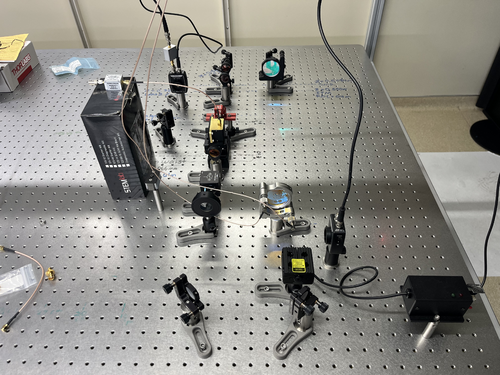
| Progress update: Photodiode is set up, need to set up DC bias tee, EOM has 400-600nm wavelength range with a resonance frequency of 0.1-100MHz. Additionally need to connect the DC bias to SR560, put it in low pass, then connect to the function generator and connect it to oscilloscope to observe. Once everything looks good and working, need to connect the driver and we can start actuating on the cavity ETM. |
| Attachment 1: thumbnail_(2).jfif
|
| Attachment 2: thumbnail_(4).jfif
|
| Attachment 3: thumbnail_(5).jfif
|
| Attachment 4: Visible_Light_Optical_Cavity_(2).pdf
|
.png "Visible_Light_Optical_Cavity_(2).pdf")
|
|
537
|
Mon Mar 10 21:32:29 2025 |
Nathan | Physics | Electronics | Beam Profiling and PBS Measurements |
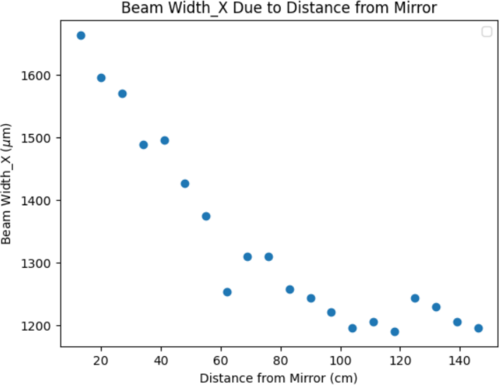
| Beam wasn't diverging, however maybe was about to diverge when measurements stopped? Will discuss the PBS measurements and how the voltage changed due to the wave plate. |
| Attachment 1: Beam_Profiling_2_20_(2).pdf
|
.png "Beam_Profiling_2_20_(2).pdf")
|
| Attachment 2: beamprfl.png
|
|
| Attachment 3: thumbnail_(6).jfif
|
|
551
|
Tue Apr 8 20:04:35 2025 |
Nathan | Update | VLC Update | PDH Lock Progress |
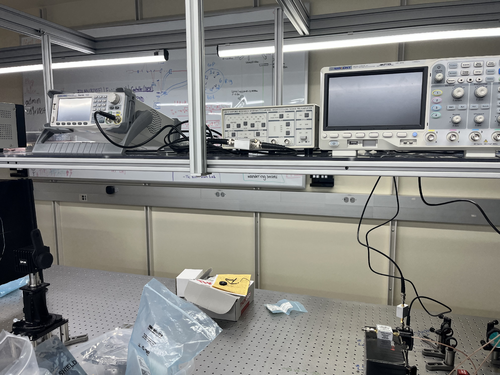
| Connected the DC bias and mixer. Need to connect signal generator now to RF Amp and mixer, and also need to connect power supply. After that will see if I can get a detection on the oscilloscope and if so will set up the driver. [Photos attached] |
| Attachment 1: IMG_5450.jpeg
|
|
| Attachment 2: IMG_5449.jpeg
|
|
|
560
|
Tue Apr 22 13:00:04 2025 |
Nathan | Update | VLC Update | Photodiode signal check and additional signal check due to 20Mhz signal and amplifier |
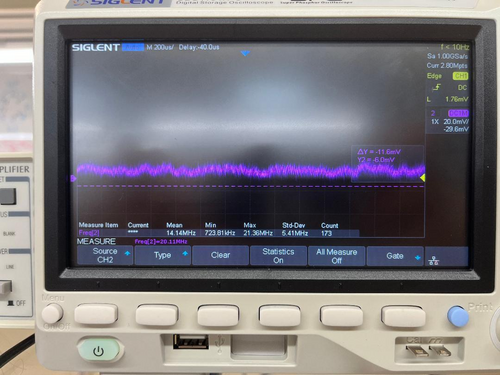
| In general, photodiode was able to achieve signal. Below are the voltage signals and frequency measurements of the photodiode with the dc bias and amplifier connected to the EOM (Vpp = 2mV for first and Vpp= 1 for second). Also I need assistance in using the PZT driver. |
| Attachment 1: thumbnail_(8)_(1).jpg
|
_(1).jpg.png "thumbnail_(8)_(1).jpg")
|
| Attachment 2: vpp.jpg
|
|
|
317
|
Tue Feb 6 22:40:25 2024 |
Michael | Update | Scripts/Programs | Long Crab 1 Design Created In Gtrace |
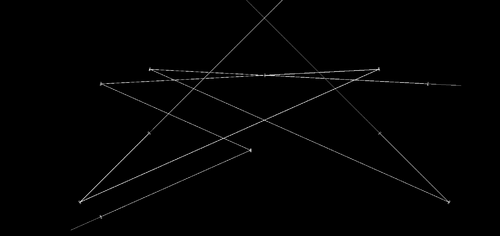
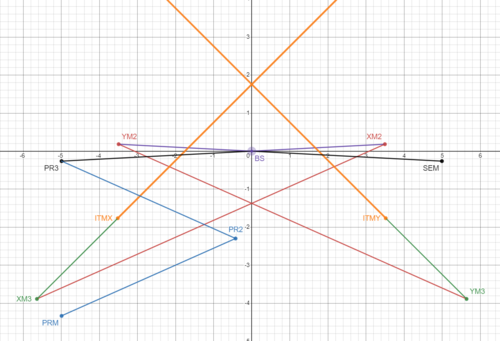
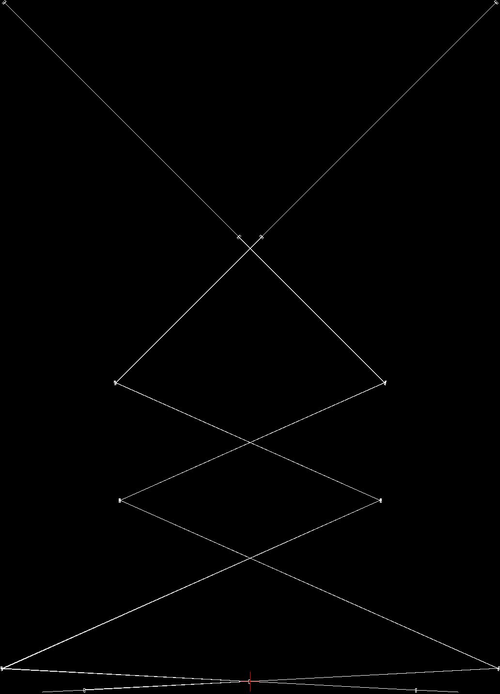
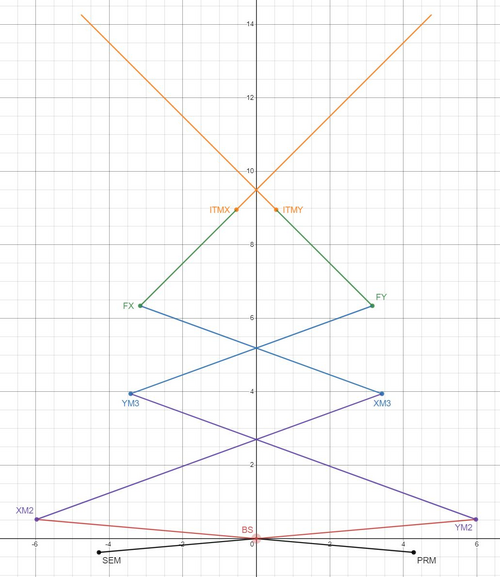
| Worked on and completed the python code for the simulation of the Long Crab 1 layout for Cosmic Explorer basing off of Pooyan's original work with the Crab 1 layout. From here I'll look into creating the shoelaces layouts. |
| Attachment 1: Long_Crab1.png
|
|
| Attachment 2: long_crab_1_desmos.PNG
|
|
|
322
|
Tue Feb 13 04:05:32 2024 |
Michael | Update | Interferometer Simulations | Shoelaces 1 Layout Simulated in GTrace |
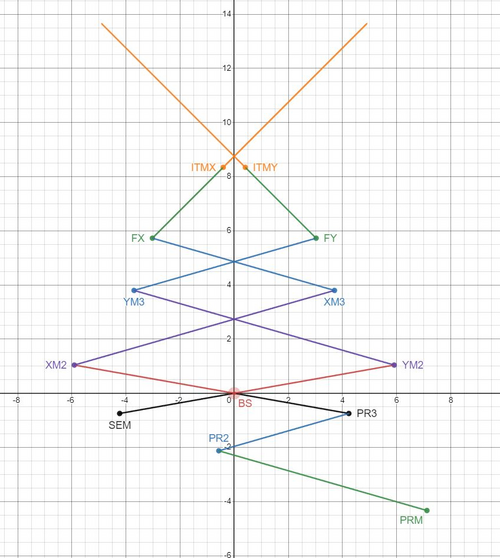
| I've worked on and have completed a first simulation of Cosmic Explorer's Shoelaces 1 layout. This is based off of Pooyan's original work with Gtrace much like the Long Crab 1 layout I worked on last week. This layout will allow me to quickly created the alternate shoelaces layouts. I've included an image of the dxf, and a desmos model for reference. |
| Attachment 1: shoelaces1_dxf.JPG
|
|
| Attachment 2: shoelaces1_desmos.JPG
|
|
|
334
|
Wed Feb 21 23:15:07 2024 |
Michael | Update | Interferometer Simulations | Long Shoelaces 1 Layout Created in Gtrace and Fixed Ghosting in Beamsplitter |
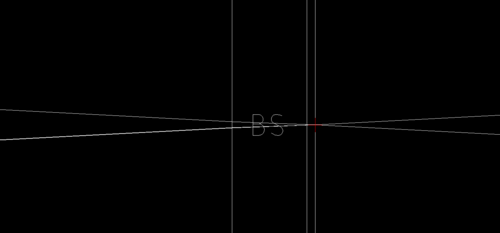
| I have created the long shoelaces 1 layout for cosmic explorer using gtrace, a slight modification from the shoelaces 1 layout design. I also modified the simulation code slightly to remove ghosting effects in the beamsplitter. Originally the python code specified that the HR and AR sides of the beamsplitter both have the same transmission/reflection. I modified this to the ideal case of: Refl_AR = 0, Trans_AR = 1. I have attached two images below to show the before and after effect of this modification. |
| Attachment 1: long_shoelaces1_desmos.JPG
|
|
| Attachment 2: AR_side_with_reflection.PNG
|
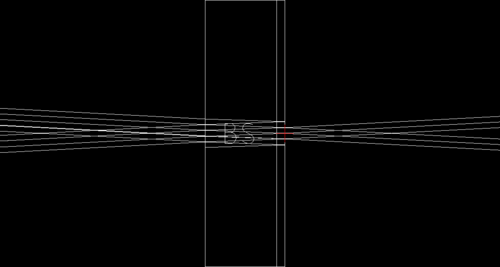
|
| Attachment 3: AR_side_without_reflection.PNG
|
|
|
342
|
Tue Feb 27 03:26:28 2024 |
Michael | Update | Interferometer Simulations | Reverse aLIGO Layout Created in Gtrace |
| I've created the simulation for reverse aLIGO layout in gtrace. Attached are the desmos model and the output dxf file. From here Pooyan and I plan to create a brief report of our progress to the CE optical design group. |
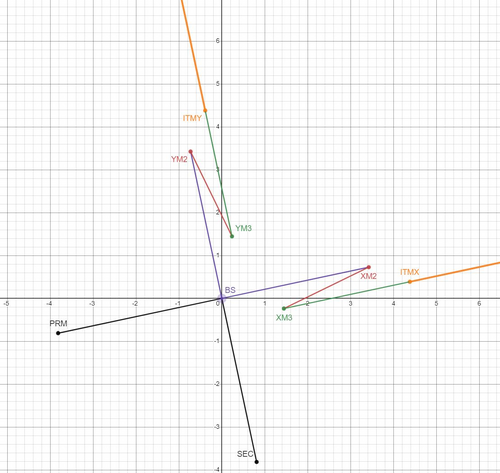
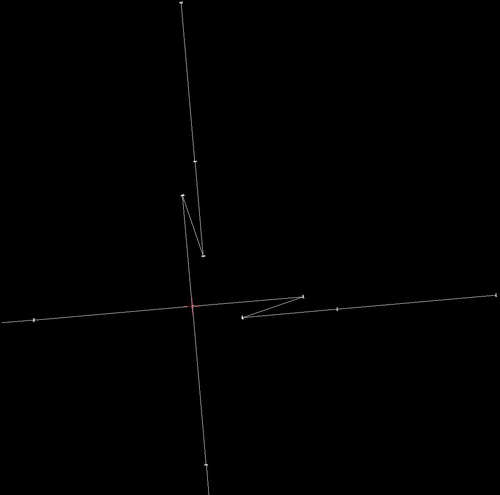
| Attachment 1: reverse_aligo_desmos.JPG
|
|
| Attachment 2: reverse_aligo_dxf.JPG
|
|
|
357
|
Sun Apr 7 13:42:51 2024 |
Michael | Update | Interferometer Simulations | Update on status of gtrace project |
| [Pooyan, Michael]
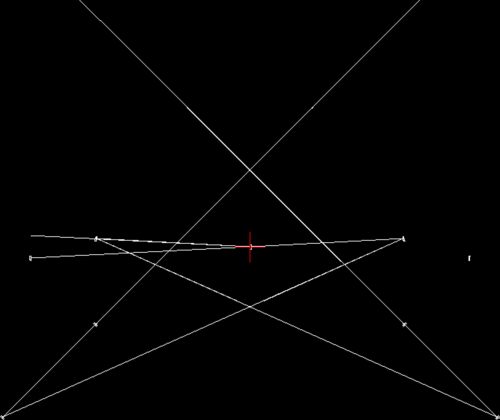
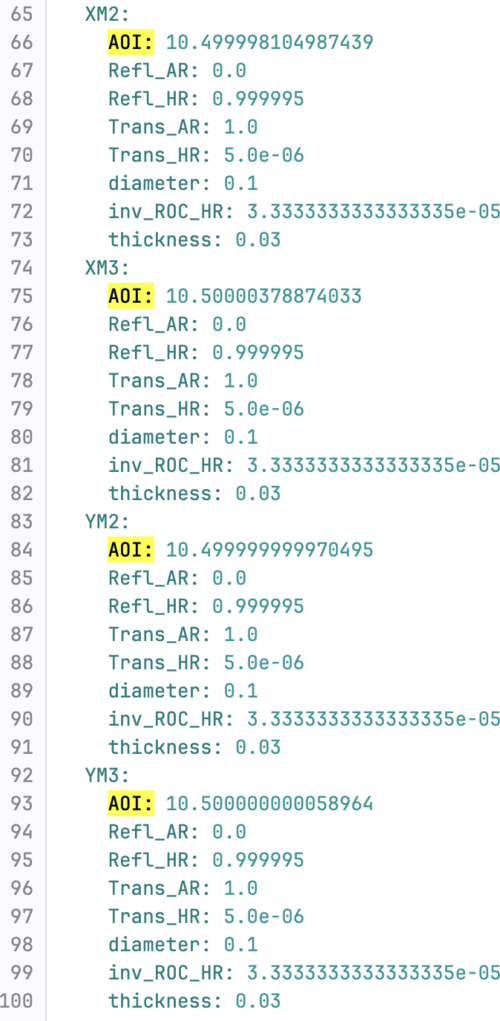
After meeting and discussing the current state of our work with Prof. Fulda a few weeks ago, we have decided that the best next step for the gtrace project is its integration into finesse work. Our first step towards this integration involved creating a sequential beam trace in contrast to the previous non sequential gtrace simulations. A sequential beam trace not only allows for faster runtimes of the simulation (<1 second) but also allows for more direct reading of certain beam parameters (beam size, gouy phase, and angle of incidence). The sequential model was created alongside a yaml output which provides values of parameters, now including the angle of incidence on a mirror.
Last Monday, Pooyan gave a report to the Cosmic Explorer optical design team on the current state of our project and the ultimate goal of our work. During the same meeting another group working in the optical design team presented their own work with gtrace and optical design, focusing more on optimization of parameters based on desired beam sizes at each mirror. It might be a good idea to begin attempting to bring our individual projects together to allow for collaboration and further developments.
Currently, only the crab1 layout has a sequential trace model. Pooyan is currently working on creating a finesse model for crab1 to serve as a proof of concept for how gtrace could be integrated with finesse by providing useful values such as angles of incidence. |
| Attachment 1: Sequential_beam_trace_crab1.png
|
|
| Attachment 2: angle_of_incidence_yaml_example.png
|
|
|
397
|
Mon Jul 8 12:26:10 2024 |
Michael | Update | Interferometer Simulations | Minimizing Astigmatic Effects in the SRC of LIGO |
| This is the first look and analysis of the effects of astigmatism in the aLIGO optical layout which can lead to mode mismatch and therefore increased losses into higher order modes. Specifically I am currently looking at measuring the effect of changing the radii of curvature of the SRC mirrors https://docs.google.com/presentation/d/1qhIehqyNukg4g8S2fqfQZz83yr9aB76tEa6fn2J-TrM/edit?usp=sharing |
|
409
|
Mon Jul 15 15:52:40 2024 |
Michael | Update | Interferometer Simulations | aLIGO locking with varying SRC mirrors and measuring mode mismatch |
|
| Attachment 1: SRC_Astigmatism_Analysis_7_15_24.pdf
|

|
|
Draft
|
Sun Aug 4 09:01:01 2024 |
Michael | Update | Interferometer Simulations | Update on SRC Mode Mismatch Analysis |
| An update on my analysis to minimize mode mismatch/scattering by introducing toroidal mirrors to the SRC. |
| Attachment 1: SRC_Mode_Mismatch_Update_8_2_24.pdf
|

|
| Attachment 2: SRC_Mode_Mismatch_Update_8-12-24.pdf
|

|
|
436
|
Mon Sep 9 12:36:45 2024 |
Michael | Update | Interferometer Simulations | Update on Analysis of Mode Mismatch Minimization in A# |
| I have taken a closer look at the solution curve in the mirror parameter space which I have searched, focusing on the "resilience" of specific points, with the plan to analyze how certain conditions of the interferometer change as we move along this solution curve. |
| Attachment 1: SRC_Mode_Mismatch_Update_9_9_24.pdf
|

|
|
482
|
Mon Dec 2 00:11:23 2024 |
Michael | Update | Interferometer Simulations | Status Update on Toroidal Mirrors Project Work |
| As it has been significant time from my last update on this project, I compiled a few notes about what I have been working on, current issues, and my future plans. The past few weeks have been focused on me attempting to obtain a reliable symbolic expression for mismatch. This is important going forward as it allows us to determine optimal points in the parameter space and the surrounding behavior efficiently without significant computational cost. However this been quite difficult since I've encountered some fundamental discrepancies in the way values like the ABCD matrix and q-parameters are calculated/returned in Finesse. Since I have yet to resolve this, I'm focusing on next steps in developing tools for statistical simulations.
Update Slides |
|
523
|
Tue Feb 25 01:37:00 2025 |
Michael | Update | Interferometer Simulations | Updates and Current Next Steps for Toroidal Mirrors Project |
| Since the previous discussion of this project, I've worked on building finesse models to verify mathematical results which model the astigmatism in a two mirror system which we attempt to minimize. This left us with a single condition for an output non-astigmatic beam. However, as can be seen in finesse simulations, there does exist other configurations which have a negligibly small astigmatism, which we may want to consider. Below I've attached the link to my overleaf project which has some updated information which I plan on discussing.
https://www.overleaf.com/project/67968921426e61d5b2fd8c96 |
|
548
|
Tue Apr 8 00:17:01 2025 |
Michael | Update | Interferometer Simulations | Squeezing Performance Graphs for Case With and Without Toroidal Mirrors in LIGO |
| I've created some graphs for the frequency dependent observed squeezing level in LIGO for both the nominal case and the case where we include toroidal mirrors, giving some interesting results. https://docs.google.com/presentation/d/1RBr47hNaxFTdGrwys5ZCUEUOgVOVHmZ2B_5EQwY62IY/edit?usp=sharing |
|
556
|
Mon Apr 21 16:56:42 2025 |
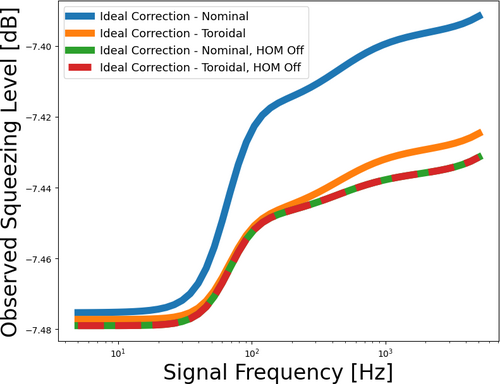
Michael | Update | Interferometer Simulations | Fixed Observed Squeezing Curve for Toroidal Mirror Case |
| We've resolved the issue with the observed squeezing curve for the toroidal mirror case showing worse performance at lower frequencies and better performance at higher frequencies compared to the nominal case. This issue was caused by the beam parameter at the squeezer being fixed before changing the radii of curvature of the mirrors. This has been changed to be fixed after changing the mirrors, and we see an improvement in the toroidal mirror case. |
| Attachment 1: updated_observed_squeezing_plot.png
|
|
|
571
|
Tue May 6 13:07:34 2025 |
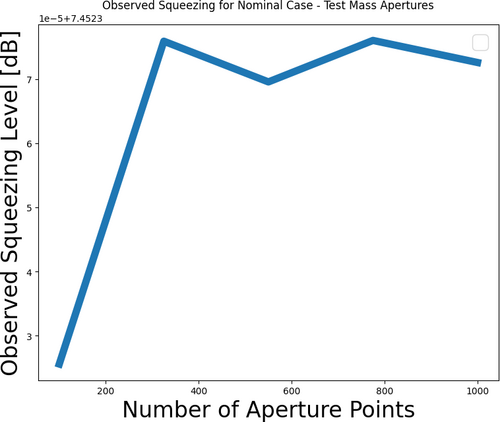
Michael | Update | Interferometer Simulations | Initial Convergence Plots for Toroidal Mirrors Project |
|
| Attachment 1: Convergence_Plots_5_6_25.pdf
|

|
| Attachment 2: Convergence_Plots_5_6_25-1.pdf
|

|
| Attachment 3: aperture_num_points_convergence.png
|
|
|
582
|
Mon May 26 23:24:33 2025 |
Michael | Update | Interferometer Simulations | Initial Monte Carlo Simulations for Toroidal Mirrors Project |
| I've run an initial Monte Carlo simulation for statistical comparison of toroidal mirrors for the dual FROSTI TCS case. Below is the link to the slides.
slideshow |
|
634
|
Tue Aug 26 12:18:36 2025 |
Michael | Update | Interferometer Simulations | Squeezing Plots for SRC Parameter Space |
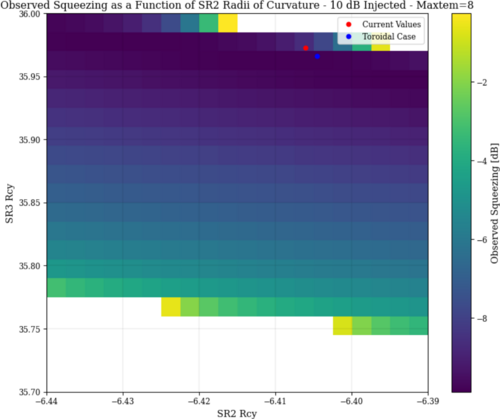
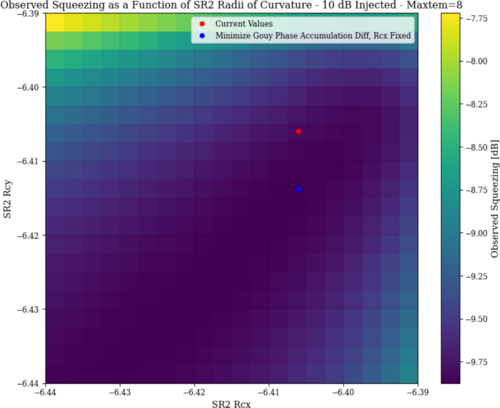
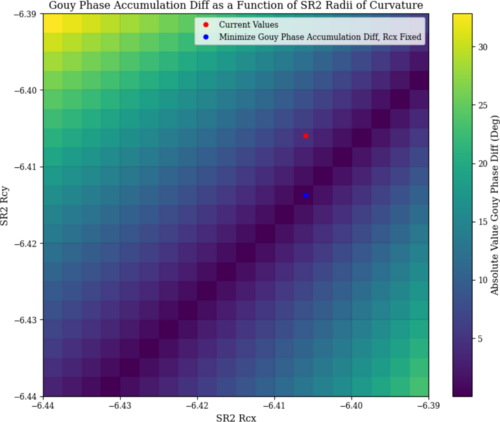
| I've run a few plots of observed squeezing in the LIGO interferometer to fully ensure that the point we have selected is the optimal point for squeezing. Contrary to what I expected, there seems to be much more degenerate "optimal" configurations. While the toroidal case may be near optimal, it seems that the solution we found for a non astigmatic beam is not the only one. I will further explore this space to find more optimal/tolerant positions, which I see evidence of.
Additionally, as observed squeezing is computational expensive to compute, I found that the difference in round-trip gouy phase accumulation between the x and y planes is a good approximation for an optimal squeezing state, which I believe makes physical sense. This may be helpful to quickly compute other optimal conditions. |
| Attachment 1: Screenshot_2025-08-26_at_12-16-01_LIGO_Project_Log_-_Google_Docs.png
|
|
| Attachment 2: Screenshot_2025-08-26_at_12-16-32_LIGO_Project_Log_-_Google_Docs.png
|
|
| Attachment 3: Screenshot_2025-08-26_at_12-17-26_LIGO_Project_Log_-_Google_Docs.png
|
|
|
Draft
|
Thu Oct 23 11:34:05 2025 |
Michael | Update | Interferometer Simulations | Updated Exploration into Different SRC Mirror Configurations for Improved Squeezing |
|
| Attachment 1: Update_Slides_10_23_25.pdf
|

|
| Attachment 2: Update_Slides_10_30_25.pdf
|

|
|
680
|
Thu Feb 5 13:49:31 2026 |
Michael | Update | Interferometer Simulations | Updating Squeezing Mode Matching Logic |
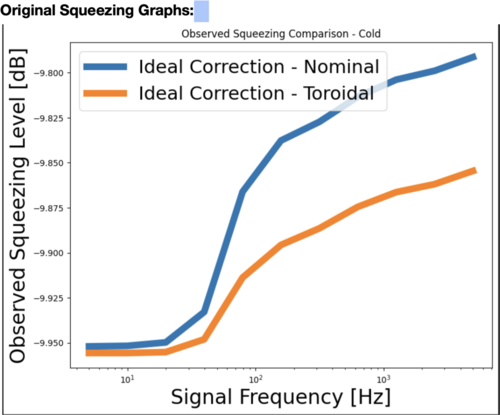
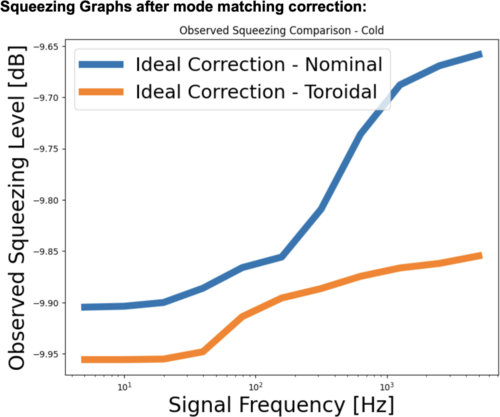
| After some tests, I have determined that the squeezer in the aLIGO katscript is currently being matched to the SRC. This logic will cause issues if the SRC mode is perturbed and no longer closely matched to arm modes. Currently, my modification to the code involves taking the arm mode incident at the ITM and propagate the beam parameter using the ABCD matrix from the ITM to the injected squeezing port. Rerunning some of the squeezing simulations for a cold interferometer, it appears the toroidal case remains the same but the nominal mirror case degrades. Is this expected when we match to the arm instead of the SRC? |
| Attachment 1: screenshot2.png
|
|
| Attachment 2: screenshot1.png
|
|
|
695
|
Thu Apr 2 12:23:40 2026 |
Michael | Update | Interferometer Simulations | Update Plots and Squeezing Behavior With Toroidal Mirrors |
|
| Attachment 1: Update_4-2-26.pdf
|

|