| ID |
Date |
Author |
Type |
Category |
Subject |
|
624
|
Mon Aug 11 22:19:50 2025 |
Christina | Update | TCS | Red Pitaya Data Streaming |
[Ma, Tyler, Christina]
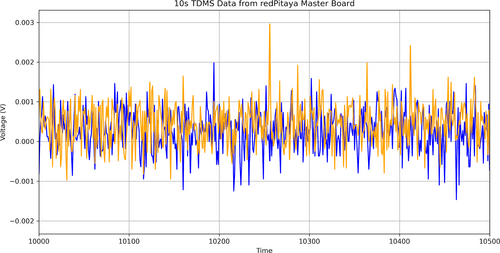
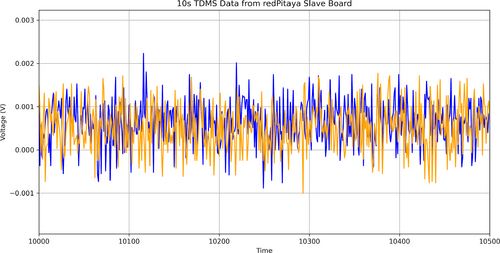
This past week, we were able to set up the data streaming for continuous acquisition to the PCs, and can conduct the initial tests now. We were able to do this by:
- Installing the correct OS ecosystems to each Red Pitaya
- Installing the terminal streaming client
- Debugging formatting and file saving issues by saving the data in a TDMS file on the host PC.
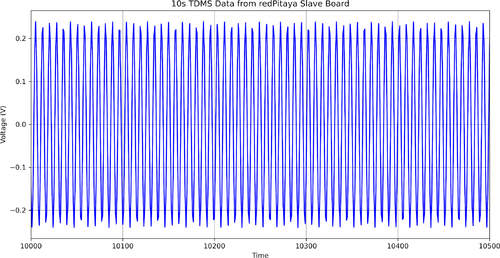
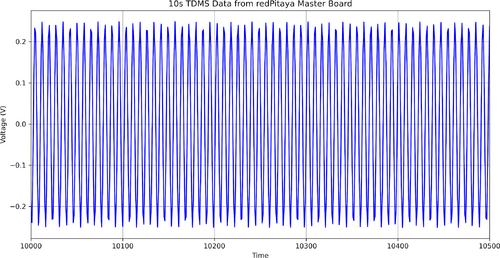
We have started streaming the ADC data on Monday from both boards for 2 days, which are currently in the clean room. Below are the ADC tests we performed before starting the 2-day run. (Time in ms) |
| Attachment 1: 3.png
|
|
| Attachment 2: 3-1.png
|
|
|
629
|
Tue Aug 12 13:46:56 2025 |
Christina | Update | | |
|
| Attachment 1: 3.png
|
|
| Attachment 2: 3-1.png
|
|
|
631
|
Tue Aug 19 12:08:40 2025 |
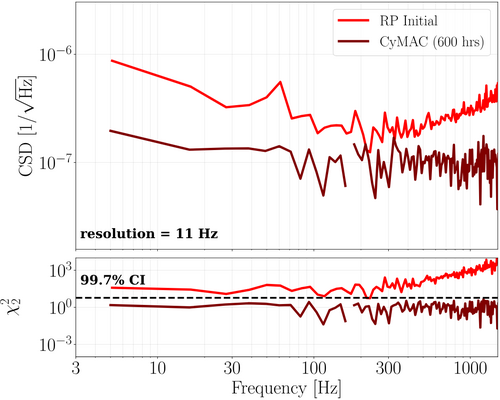
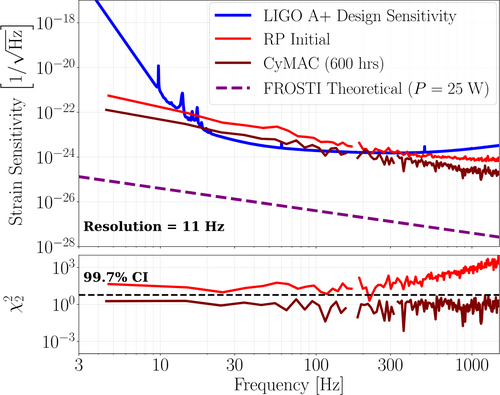
Christina | Update | TCS | RP Initial vs CyMAC Plot Comparisons |
| [Tyler, Ma, Christina]
These are the frequency averaged and veto binned plots for the initial Red Pitaya and CyMAC systems. |
| Attachment 1: 11hzCSD.png
|
|
| Attachment 2: 11hzstrain.png
|
|
|
173
|
Thu Jul 27 10:18:43 2023 |
Celeste | Update | TCS | Graphical Updates to HOM RH Modification |
| Attached are updated graphs of the irradiance distribution from the 1/8th ring heater units (extruded and reduced in length). |
| Attachment 1: HOM_RH_1_8_Unit_Modification_Graphs.pdf
|

|
|
180
|
Fri Jul 28 17:45:45 2023 |
Celeste | Update | TCS | Graphical Updates to HOM RH Modification, Friday 7/28 |
| Updated 1/8th Heater simulation modification graphs. Slides 7, 10, 16-19 are new additions. |
| Attachment 1: HOM_RH_Simulation_Progress.pdf
|

|
|
187
|
Tue Aug 1 16:22:35 2023 |
Celeste | Update | TCS | Graphical Updates to HOM RH Modification, Tuesday 8/1 |
| Slides 20-33 are newly added (data/graphs from parameter sweep feature-1/8th heater unit length varied from 10% of original to 100% of original). |
| Attachment 1: HOM_RH_Simulation_Progress_80123.pdf
|

|
|
200
|
Thu Aug 10 14:13:38 2023 |
Celeste | Update | TCS | 8/10/23, Simulation Graphical Progress |
|
| Attachment 1: Simulation_Progress__8_10_23.pdf
|

|
|
204
|
Fri Aug 11 10:57:20 2023 |
Celeste | Update | TCS | 8/11/23 Simulation Progress |
|
| Attachment 1: Simulation_Progress__1_32nd_Model_(1).pdf
|
.png "Simulation_Progress__1_32nd_Model_(1).pdf")
|
|
209
|
Tue Aug 15 16:10:06 2023 |
Celeste | Update | TCS | 8/15/2023 Simulation Progress |
|
| Attachment 1: Simulation_Progress__1_32nd_Model_(2).pdf
|
.png "Simulation_Progress__1_32nd_Model_(2).pdf")
|
|
586
|
Tue Jun 3 11:54:06 2025 |
Cece Ochoa | Update | | CE Cavity Design Update |
| Update on the design for the CE Cavity Mirrors |
| Attachment 1: CE_Arm_Cavity_.pdf
|

|
|
659
|
Thu Nov 6 12:39:43 2025 |
Cece Ochoa | Update | ELOG | CE Cavity Design Update |
| Updated mode placements and ROC. No thermal effects added yet. |
| Attachment 1: base_0_6_plot.pdf
|

|
| Attachment 2: base_0_7_plot.pdf
|

|
|
663
|
Thu Nov 20 13:03:58 2025 |
Cece Ochoa | Update | ELOG | CE Cavity Design Update |
| Update on grouping 0+8th Order Modes |
| Attachment 1: 11_20_update.pdf
|

|
|
675
|
Thu Jan 29 12:46:22 2026 |
Cece Ochoa | Update | | CE Cavity Design Update (4) |
| Update for CE Cavity Arms + Modes
https://docs.google.com/presentation/d/1-dXYylkAbNpHR4WVCx9Q8ryL_xGlH-JSSLXEUQg6b7Q/edit?usp=sharing |
|
683
|
Thu Feb 12 12:53:51 2026 |
Cece Ochoa | Update | ELOG | CE Cavity Design Update |
| Update on HOM placement w/ cavity locking. Still verifying mode placement
RoC: 28340m and 26874m |
| Attachment 1: 2_12_short_update.pdf
|

|
|
Draft
|
Thu Mar 12 13:18:49 2026 |
Cece Ochoa | Update | Interferometer Simulations | CE Cavity Design Update |
| Animation showing how modes shift in the CE arm cavity for radius 27581m and mirror radius of40cm as the laser powers up the 1.5 MW.
https://drive.google.com/file/d/1UNvWmONWYDzroelC5j_Z2emGSotyzcCC/view?usp=sharing |
|
702
|
Thu Apr 23 11:32:48 2026 |
Cece Ochoa | Update | Interferometer Simulations | CE Cavity Design Update |
| Update on CE Mirror RoC, simulation with FROSTI and cavity locking
View Presentation |
|
717
|
Mon Jun 15 22:30:09 2026 |
Cece Ochoa | Infrastructure | Inventory | Optics Inventory |
| Spreadsheet of all tabletop optical parts in 1129 (Cabinet 1) linked here
Note that a couple of the optical posts still need to be measured for their diameters. Images are located in a Google Folder and linked on the spreadsheet so to view them you have to go to the Google Sheet. |
| Attachment 1: Optics_Inventory_(1).xlsx
|
| Attachment 2: Optics_Inventory_-_Sheet1.pdf
|

|
|
724
|
Thu Jul 2 11:09:09 2026 |
Cece Ochoa | Update | Inventory | PPE/Cleaning Supplies Inventory |
| [Shane, Cece]
Shane has made a Google Form to take inventory of PPE and cleaning supplies.
Additionally, she has made a form for purchase order requests.
Please use the first form to take inventory when NEW supplies arrive, and in future cleanings use the form to take inventory so we can have an accurate count of what is in the lab.
I have also made an optics inventory form that will update the previous optics inventory spreadsheet. |
|
722
|
Thu Jun 25 13:21:31 2026 |
Cece | Update | Inventory | Optics Inventory Update |
| [Shane, Ma, Cece]
Updated optics inventory here.
Changes made: removed thrown out optics from sheet, added new optics found during Ma and Shane's cleaning, updated optics location (now all in 1119 optical cabinets, mostly in labeled yellow bins). |
|
741
|
Sun Jul 26 13:07:04 2026 |
Cece | Update | Inventory | Vacuum Part Inventory |
Took a more comprehensive inventory of the vacuum chamber parts on the optical table in 1129. Made note of scratches, chips, stains on each part.
Next steps: update inventory spreadsheet with the annotated photo, check hoses, o-rings, and KF clamps in 1125. |
| Attachment 1: Issues_with_parts.pdf
|

|
|
6
|
Tue Jun 21 18:31:49 2022 |
Cassidy and Phoebe | Update | Cameras | IR Absorbing Screen and FLIR Camera Setup |
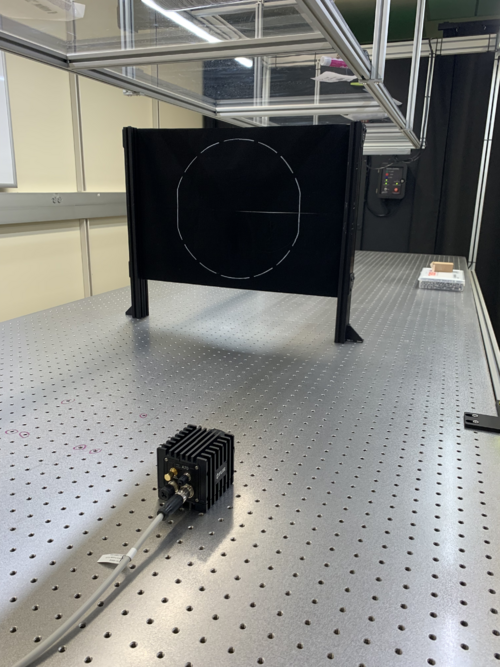
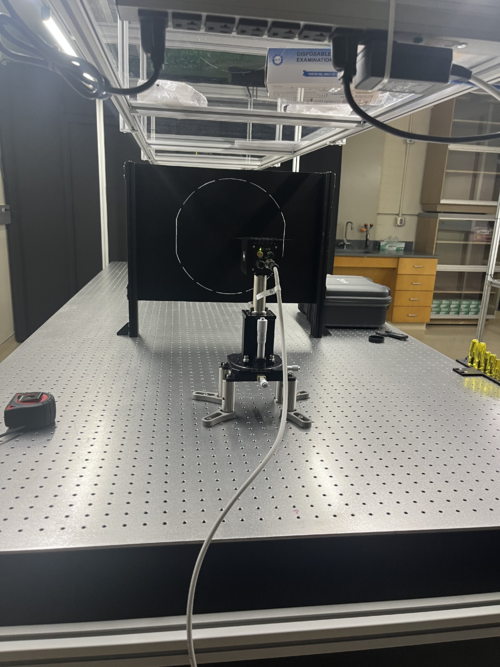
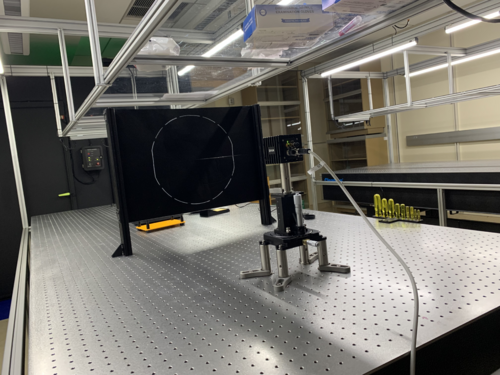
Today we set up the IR absorbing screen and the camera on the optical table, as well as tested that the camera was functioning as expected (picking up heat sources beyond the screen).
Screen Setup
The screen was set up by clamping it between two rectangular posts on each side. First, two posts were set up with 22 in. between them (thus allowing the screen to span a total distance of up to 24 in. when clamped down). To best stabilize the screen and to allow for it to be "pulled" taut by exploiting the give in the L-bracket, the L-bracket was bolted on the outside of the post, along the same axis as the screen itself.
On first attempt, the screen was too thin to be fully clamped between the posts. In order to have it fit snugly, sections of heat shrink tubing was used as a shim at the points where the posts were clamped together. The tubing was slid into the track of one optical post at the desired points. In order to accommodate the shim, the two posts had to be held together, ideally clamped, with the screen and shim in place. Then, the post clamps could be slid into the tracks of the post, moved to the optimal location, and tightened down. This required at least three people: two to tighten one side while the third holds up the screen on the other side. The screen was placed ~1/8" from the edge of the posts and flush with the top.
Camera Stage Setup
Once the screen was in place, the camera stage was set up by placing the XY-Translational with Rotation stage on four 3" optical posts. Then, the z-axis stage was placed in the center of that, with another 3" optical post on top, which was then topped with the camera. This was set and clamped down ~22.5" from the screen. This was about 1" closer than expected based on our theoretical models.
Fine Alignment
We used the visible camera to fine align the screen and to test the setup. Notably, the visible camera is placed below the infrared and thus requires a calibration in order to ensure the two are aligned on the computer image. This can be set by hand using the FLIR proprietary software (FLIR CamWeb) and adjusting the "MSX alignment". The image mode "Thermal MSX" allows both the visible and IR camera to be displayed at once and the difference in their positioning can be seen. We found an offset of ~0.5m to be nearly accurate (note: using this method, although you can get more accurate than this, the displayed value only has one significant figure).
In order to align the camera, we first used the exposed top edge to judge whether the camera was appropriately centered on the screen. We set the rotation as close as possible to being in line by eye, then adjusted the y-axis until the gap on both corners was a similar size, thus indicating that the rotation and y-position were correctly set. Rotationally, the camera required only a refinement of -1/2 degree. The y-axis is set at 1.25. Then, the camera was pulled as far from the screen as possible using the x-axis to allow the screen to be easily centered using the z-axis. Once the outlined test mass was centered, the x-axis was used to bring the camera close until the screen just barely filled the field of view. The x-axis is at 2.25. The z axis is set to it full dynamic range at 10. Unfortunately, the camera is still slightly too tall for the screen, likely requiring the purchase of a new optical post about 0.5in shorter the current one. This interchange will likely require a new fine alignment after.
Basic Imaging Tests
The camera was also focused on the screen based on the manufacturer's printed distance on the camera itself (using 22.5", or 0.572 m). Using the FLIR proprietary software, the camera appears to be in focus in IR (a hand was used as a good focusing tool for this). Additionally, the camera does pick up heat on the other side of the screen. A hand can be lightly seen warming the screen, as can a soldering iron tip. This was a very imprecise visual tool, but does indicate that the camera and screen are working roughly as expected.
Next Steps
A new optical post that is ~2.5" tall should be ordered to replace the one under the camera currently. The heating system also needs to be ordered and set up. Currently we are debating between a parabolic reflector with a hole in the back, and one without, as each would require a different mounting mechanism for the cartridge heater. |
| Attachment 1: IMG_6751.png
|
|
| Attachment 2: IMG_1146.png
|
|
| Attachment 3: IMG_6756.png
|
|
|
9
|
Tue Jul 26 14:10:35 2022 |
Cassidy | Update | Cameras | Optical Post Replacement and Realignment |
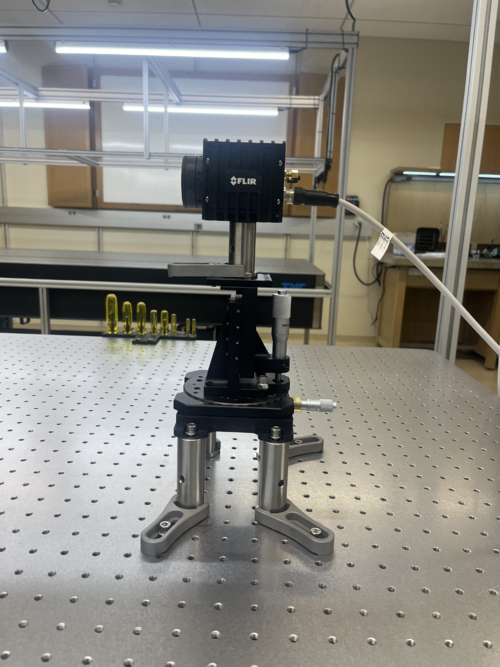
| Today I replaced the 3" optical post that the camera rests on with a 2" optical post in order for the screen to correctly fill out the camera's FOV. The 3" post is now in the glass optics cabinet next to the FLIR camera configuration box, wrapped in the protective materials from the 2" post for safekeeping.
There were no issues with the physical replacement of the post, except that the fork clamp on the post needs to be on one of the perpendicular, not diagonal, axes in order to be secure. I chose the front axis (towards the screen) as before in order to easily access the alignment knobs.
To align, I followed the same process as last time except for a more purposeful original rough alignment. For alignment purposes, the visual camera was used. For the first rough alignment, I pulled the camera as far back as possible on the x axis (with the z axis roughly centered), then moved the entire stage setup back until I could just see both the top and bottom edge of the screen. Then, I set the z-axis to an extreme in order to use the edge of the screen to align the rotational and y-axis pieces for the fine alignment.
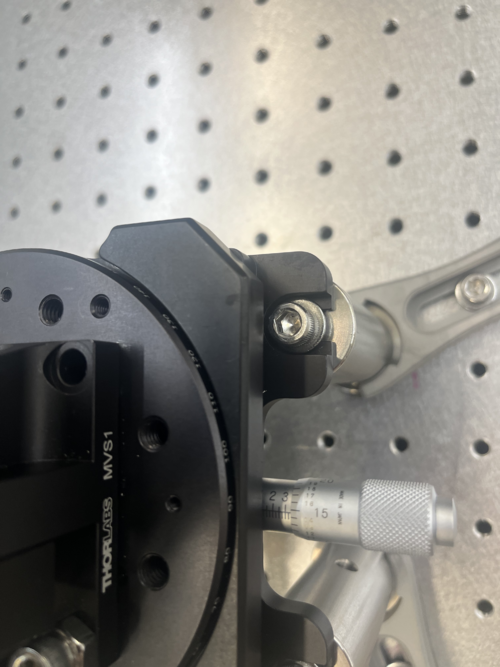
For the fine alignment, starting with the z and x axis at extremes, I began by aligning the rotational axis. To do this, I used the gaps between the top of the screen and the camera window on the far left and right of the image. When these gaps were equal I knew the rotation was adequately set. Then, I set the y-axis so that the pattern was centered. If the gaps were no longer even, I redid the rotation alignment and ditto with the y axis until both were set. This resulted in a rotation of about two degrees and a y axis at just under 3.5.
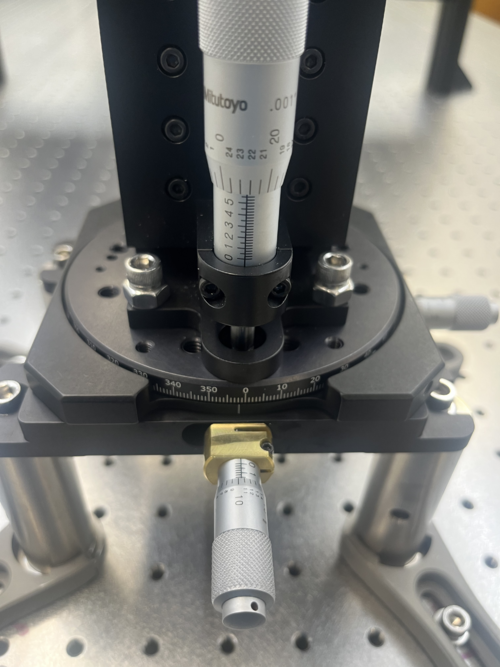
To set the z and x axis, I centered the z-axis using the top and bottom of the screen, which should both be visible if the rough alignment was done correctly. Then, I adjusted the x axis by pushing it forward until the top and bottom of the screen were just out of the frame. As with the rotational and y-axis, I iteratively fine tuned the x and z axis until both the image was centered in the z axis and only the screen was in view. This resulted in a z-axis value of just over 5.5 and an x axis value of nearly 1.75.
Pictures are included of all alignment knobs and the new post/stage setup! |
| Attachment 1: YAxisAlignment.png
|
|
| Attachment 2: XRotZAlignment.png
|
|
| Attachment 3: NewOpticalPost.png
|
|
|
81
|
Thu Apr 27 16:23:44 2023 |
Cao, Pamella and Julian | Physics | VAC | Installing vacuum system (cont.) |
[Pamella, Cao and Julian, Shane]
- Particles account
- 10:37 am: Starting the particles account
- Zone 3:
- 0.3u: 1662
- 0.5u: 872
- 1.0u: 415
- Zone 4:
- 0.3u: 831
- 0.5u: 124
- 1.0u: 0
- 11:14 am: Start removal of calibrated leak to install 45 deg elbow
- 11:21 am: Elbow installed, re-install calibrated leak back on
- 11:29 am: Finished re-install calibrated leak, start installing gate valve on pump line
- 11:47 am: Finished installing gate valve, start installing reducing cross onto gate valve
- 12:02 pm: Finished installing reducing cross, start installing 90 deg elbow to reducing cross
- 12:17 pm: Finished installing reducing cross, lunch break
- 01:24 pm: Come back to the lunch break.
- 01:26 pm: Start installing vacuum hose to elbow.
- 01:40 pm: Finished installing vacuum hose.
- 01:43 pm: Start installing turbo pump.
- 02:00 pm: finished installing turbo pump .
- 02:10 pm: Start installing standard wall hose from turbo pump to scroll pump
- 02:21 pm: finished installing hose onto scroll pump, start installing lid. Remove lid from chamber, insert viton O-ring. Place lid back
- 02:30 pm: Secure lids with screw. Start installing turbo pump controller cable: Pass cable from outside (controller) up the top of clean tent and connect to 8 pin connector on turbo pump
- 03:00 pm: Installing air cooling unit for turbo pump, found 8 M3 screws for air cooling unit in the C&B cabinet to install the fan bracket onto the back of turbo pump. Fan control cable is routed up to the top of the cleanroom to the controller
- 03:15 pm: Installing full-range gauge cable to the controller outside cleanroom. Ethernet cables 1 and 2 are used. Cable 1 is used on the RGA line gauge. Cable 2 is connected to the main body gauge. Cable1 and 2 are connected controller's channel 1 and 2 respectively.
- 04:00 pm: Finish installing gauges cables. Cables are routed up along the frame to the controller sitting outside the cleanroom
- 04:15 pm: Finished. End-of-date particle count
- Zone 3:
- 0.3u: 3699
- 0.5u: 1454
- 1.0u: 872
- Zone 4:
- 0.3u: 1662
- 0.5u: 706
- 1.0u: 290
|
| Attachment 1: IMG_0139.png
|
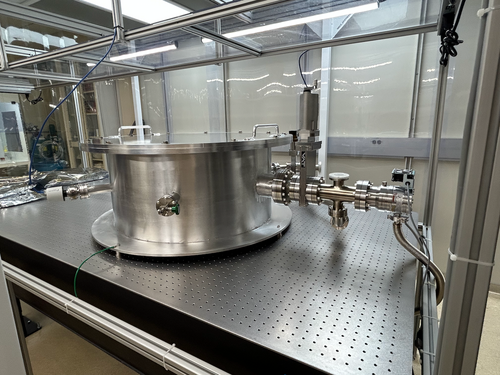
|
| Attachment 2: IMG_0136.png
|
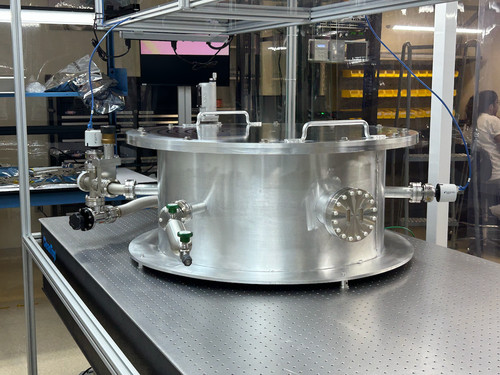
|
|
11
|
Mon Oct 3 17:21:39 2022 |
Cao | Update | TCS | Inspection of macor parts |
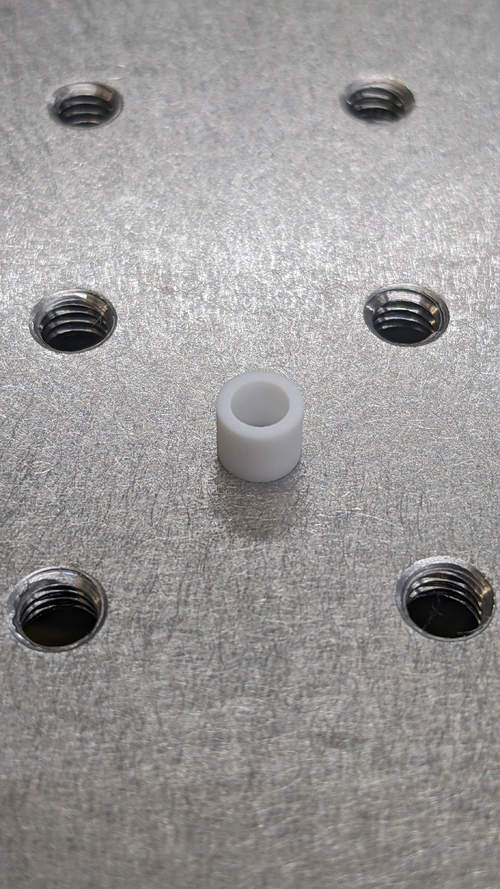
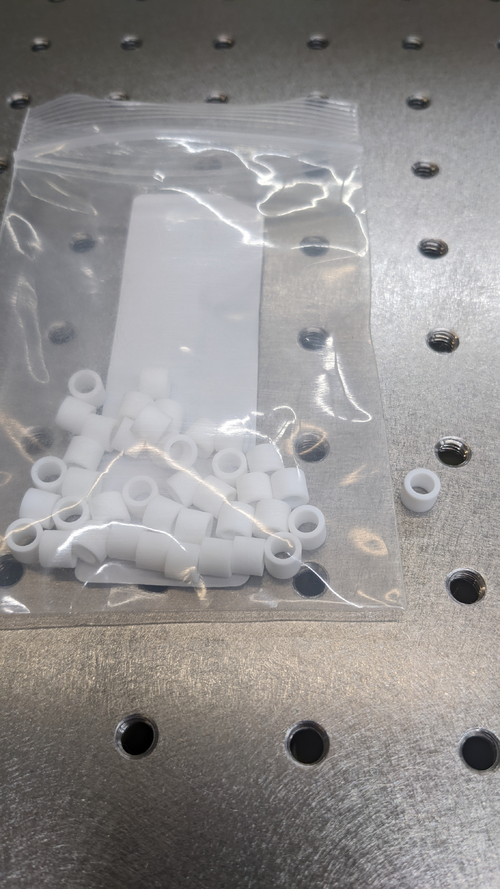
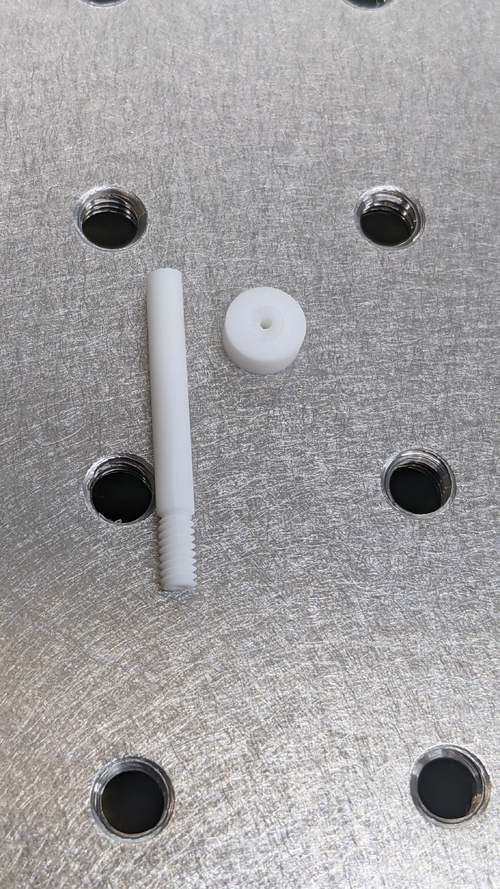
The macor parts arrived and inspected today. These include:
- Macor spacer (drawing:
LIGO_Redesign_Macor_Spacer_Drawing_v4.pdf attached below), quantities: 40
- No defects, damages observed
- Parts are free from grease/ machining fluid
- Wall thickness of 1 mm appear to provide sufficient stiffness to part
- Images of parts:
Macor_spacer_0.jpg, Macor_spacer_1.jpg
- Macor 5-40 UNC screw (drawing:
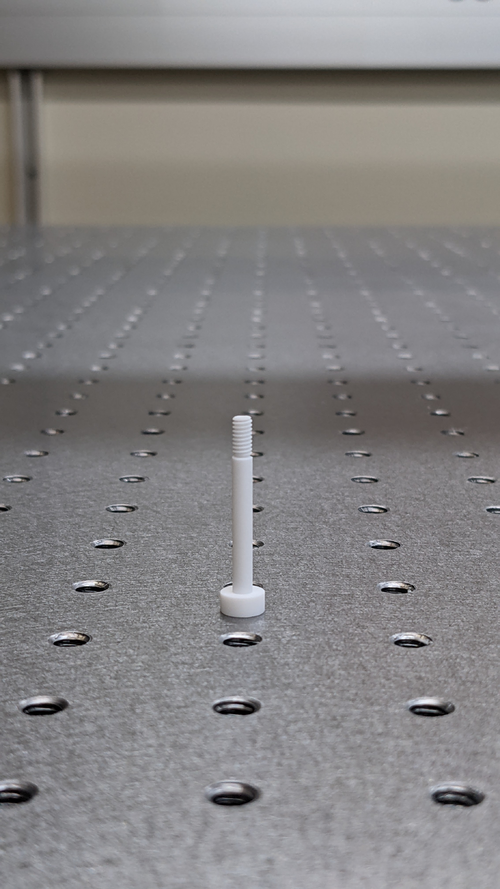
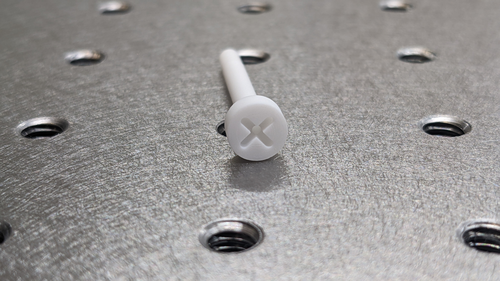
LIGO_Redesign_Macor_Screw_Drawing_v6.pdf attached below), quantities: 20
- One screw broke, location of break: should edge between head and shaft (see image
Macor_screw_5.jpg )
- All other screws look ok, no damage observed, clean surface overall
- Images:
Macor_screw_0.jpg , Macor_screw_4.jpg
|
| Attachment 1: LIGO_Redesign_Macor_Spacer_Drawing_v4.pdf
|

|
| Attachment 2: Macor_spacer_0.jpg
|
|
| Attachment 3: Macor_spacer_1.jpg
|
|
| Attachment 4: LIGO_Redesign_Macor_Screw_Drawing_v6.pdf
|

|
| Attachment 5: Macor_screw_5.jpg
|
|
| Attachment 6: Macor_screw_0.jpg
|
|
| Attachment 7: Macor_screw_4.jpg
|
|
|
67
|
Tue Apr 11 13:15:40 2023 |
Cao | Infrastructure | Clean & Bake | Nitrogen gas tank replaced |
| The nitrogen gas tank has been replaced with a new unit. The new tank is ultra pure nitrogen (>99.9% nitrogen).
The new tank has been placed and secured to the rack where the old one is; cap is removed and regulator is reinstalled onto the new tank. |
|
70
|
Wed Apr 12 16:13:19 2023 |
Cao | Physics | VAC | Vacuum prep and installation |
Aiden, Pamella, Peter, Shane, Cao
Today we started vacuum chamber assembly work
- 10:16 am: Particle count measurement of clean room
- 10:34 am: Particle counting finished: meets ISO 5 standard
- Zone 3 :
- 0.3 u: 3159
- 0.5 u: 789
- 1.0 u: 83
- Zone 4 :
- 0.3 u: 498
- 0.5 u: 41
- 1.0 u: 0
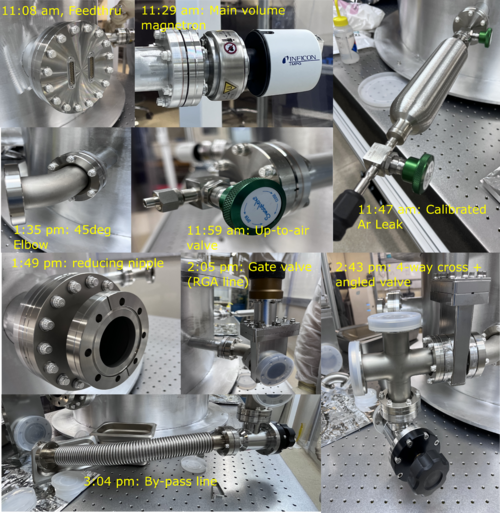
- 10:45 am: Assemble vacuum feedthrough
- 11:08 am: Finish assembling feedthrough
- 11:14 am: Assemble inverted magnetron pirani gauge
- 11:29 am: Finish assembling magnetron gauge
- 11:31 am: Assemble calibrated Ar Leak
- 11:47 am: Finish assembling Ar leak
- 11:49 am: Assemble up to up-to-air valve
- 11:59 am: Finish assembling up-to-air valve
- 12:00 pm: Break for Lunch
- 1:00 pm: Came back from lunch
- 1:20 pm: Assemble 45 degree elbow [RGA Line]
- 1:35 pm: Finish assembling 45 degree elbow
- 1:35 pm: Assemble Reducing nipple [Pump Line]
- 1:49 pm: Finish assembling Reducing nipple
-
1:53 pm: Attempt to install gate valve [Pump line] but bolts could not fit to the gap between 2.5" reducing nipple (0.95" length, shortest 5/16 bolt is 1.5" in total length).
Thickness of of CF flange on reducing nipple is 0.75" inch. Ideally, we want to have 0.2" engagement to the gate valve, thus0.95" + 0.25" head thickness = 1.2" > 0.95" gap.
We thus most likely will need a replacement for the reducing nipple. We decided we would hold up on installing the rest of the pump line until we have got components to fix this problem
- 2:05 pm: Assemble gate valve [RGA line]
- 2:15 pm: Finish assembling gate valve [RGA line]
- 2:18 pm: Assemble 4-way cross [RGA line]
- 2:30 pm: Finish assembling 4- way cross [RGA line]
- 2:37 pm: Assemble manual bellow sealed angle valve [RGA line]
- 2:43 pm: Finish assembling sealed angle valve [RGA line]
- 2:45 pm: Assemble inverted magnetron pirani gauge [RGA line]
- 2:55 pm: Finish assembling magnetron pirani gauge [RGA line]
- 2:56 pm: Assemble vacuum hose, thin wall [RGA line]
- 3:04 pm: Finish assembling vacuum hose, thin wall [RGA line]
- 3:45 pm: Packing up for the the day
- 4:00 pm: End-of-date particle count measurement
- Zone 3
- 0.3 u: 1080
- 0.5 u: 124
- 1.0 u: 83
- Zone 4
- 0.3 u: 540
- 0.5 u: 83
- 1.0 u: 83
|
| Attachment 1: VacAssy230412.png
|
|
|
84
|
Fri Apr 28 18:16:57 2023 |
Cao | Physics | VAC | Grounding vacuum system |
| Quote: |
This afternoon I made up a green 10 AWG grounding cable and connected it to the vacuum system.
One end is tightly connected to the bottom flange of the vacuum chamber (photo 1). It is run along and up the table framing to the top of the cleanroom, where it exits into the overhead cable tray in the same location as the other power cables. It drops down from the top of the server rack all the way to the bottom, where the other end is connected to the lab's electrical ground in the rear of the 240 V UPS (photo 2).
The connections were confirmed to be secure, but continuity testing with an ohmmeter remains to be done to confirm that the chamber and tabletop are indeed grounded. |
[Cao]
Continuity Test
Following from Jon's grounding work on the vacuum system, I did a continuity test with the afternoon with a multimeter. The chamber is indeed grounded:
- Chamber wall to optical table: continuity confirmed, resistance: 0 Ohm
- Chamber wall to ground point connection on chamber: continuity confirmed, resistance: 0 Ohm
- Turbo pump to ground point connection on chamber: continuity confirmed, resistance: 0 Ohm
- Turbo pump to optical table: continuity confirmed, resistance: 0 Ohm
- Optical table to chassis frame outside cleanroom: continuity confirmed, resistance: 0 Ohm
- Front of chassis frame to earth point: continuity confirmed, resistance: 0 Ohm
|
|
85
|
Fri Apr 28 19:00:13 2023 |
Cao | Physics | VAC | Tighten CF ports on vacuum chamber |
| [Cao]
After Jon's comment yesterday that some of the connection did not seem to have good metal-metal contact, in particular the gate valve connection, I went through the ConFlat connections today and retighten them.
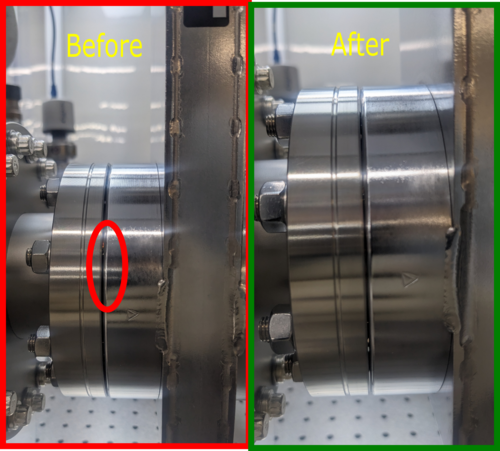
I found a lot of the CF connections are not particularly tightened and there were a lot of range left that can be tightened with the wrench. After re-tightening, the copper gaskets are not visible anymore. For example, see the attached images for the difference before and after tightening.
Note for future installation of CF
- After tightening the bolts/ screws in jumping order (to provide uniform torque) and there is resistance appearing in further tightening, start going through each screw/ bolts in a direction, each time applying a small torque until it resists to further tightened
- After each time going all the bolts/ screw and returning to the starting point, one will find they can further tighten the screws/ bolts. Repeat the process until no further tightening can be achieved
- The copper gasket should not be clearly visible at the connection
|
| Attachment 1: TightenCF.png
|
|
|
86
|
Fri Apr 28 19:39:19 2023 |
Cao | Summary | General | Clean and Bake Leybold TTR 91 Pirani Gauge |
| Quote: |
| I took batch 12 out of the oven and put them in a bag and placed the bag inside the clean room in the first large stainless steel container.
I also looked at the small gauge that we felt like needed to be baked and I can confirm that without further cleaning around the inside of the gauge it should not be connected to the main vacuum. I have attached a photo of the inside of the gauge. |
Following the problem with contamination particles observed in the the Leybold thermovac TTR 91, we have taken the following step to clean the gauge:
- Wipe with IPA-wetted Vectra Alpha: Cover the tip of a ziptide with Vectra Alpha wipe corner that has been wetted with IPA, push the wipe around and remove visible particulates
- Fill the gauge flange with IPA: (following Jon's recommendation to use Lesker's procedure for cleaning their Pirani gauge), flip the gauge up such that the CF flange points upward, fill the flange with IPA all the way up. Use the tip of a SSTL tweezer to agitate the IPA. Let it sits for 20 minutes, agitate every 5 minutes. After 20 minutes, pour the IPA out then spray with dry pure nitrogen
- Passive drying : Let the gauge sit inside the flowbench for 3 hours (3:30 pm to 6:30 pm)to ensure all IPA has evaporated
- Baking : Leave the gauge in oven at 50 degree C for 48 hours (maximum allowed temperature is 65 deg C, we use 50 deg C to ensure we are well below this limit). Baking started at 7pm, should finish on Sunday 7pm and ready for assembling to vacuum chamber on Monday morning
|
|
98
|
Sun May 14 15:50:48 2023 |
Cao | Infrastructure | Computers | High resolution display of logrus machine |
| [Cao]
The display resolution of the logrus has been 1064x768 and has been the only option, which is not great. While remote access to logrus using rdesktop allows rendering a virtual display of user's chosen resolution, it is not fast when using graphic-intensive program. NoMachine allows user to take over and control the machine remotely and thus appears as the same machine. However, NoMachine cannot render a virtual display like rdesktop. This has been limiting the resolution of using logrus via NoMachine.
On Friday, I found that even though we had NVIDIA Quadro P600 graphic card installed, we were not actually using it. The monitor has been connecting to the the integrated VGA display connector. This uses Microsoft Basic Display Adapter which limits the the resolution. Today I got a HDMI to Mini-display cable to connector the monitor to the Nvidia graphic card. Then in Display settings, go to Graphic settings, then enable Hardware-accelerated GPU scheduling. After restarting the machine, the machine recognised the Display 2using the Nvidia Quadro P600. In multiple displays field, selected "Show only on 2" and remove the VGA connection to the monitor. Logrus is now set at Nvidia Qadro P600 native display resolution of 1920x1080. This is now also the display resolution in NoMachine.
|
|
130
|
Wed Jun 21 20:25:05 2023 |
Cao | Infrastructure | VAC | Vacuum chamber bake attempt 1 |
TL;DR:
We are not yet able to bake the chamber at 150 deg C due to some current limit, most likely caused power supply switching off. Also, smoke was observed at some insulation points, mainly in the small arm sections, This is likely because the insulation does not fit well and the velcro came into direct contact with heat tape. Some Velcro (made from Nylon/ Polyester) has lower melting temperature point (in 90-120 deg C range)
Full version:
20 June 23:
- Turn off heater (short term testing) Close valves to RGA line and main volume. Pressure (Torr) readout:
- Gauge 1 (main volume): 3.43E-6
- Gauge 2 (RGA line): 2.61E-6
- Gauge 2 (pump line): 3.8E-4
- Turn off turbo pump, let vacuum line vent
- Connect high temperature control unit to main power, power up, set setpoints:
- Temperature setpoint: 150 deg C
- High temperature setpoint (to switch off) : 175 deg C
- Hysteresis: 10 dec C
- change setpoint of PID control unit to 150 dec C, with high alarm set at 165 deg C
- Connect power output of high temperature control units to PID temperature control units, ensuring both are off
- Turn off scroll pump
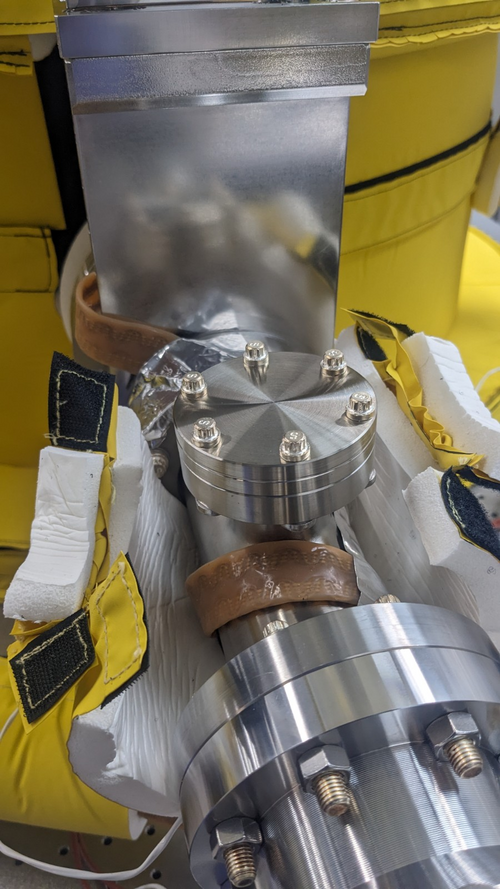
- Replace Pirani gauge in front of turbo pump with blanks (see image)
- Pump the vacuum line back down
- Open up valves and wait until pressure of full system drop back down to 1E-6
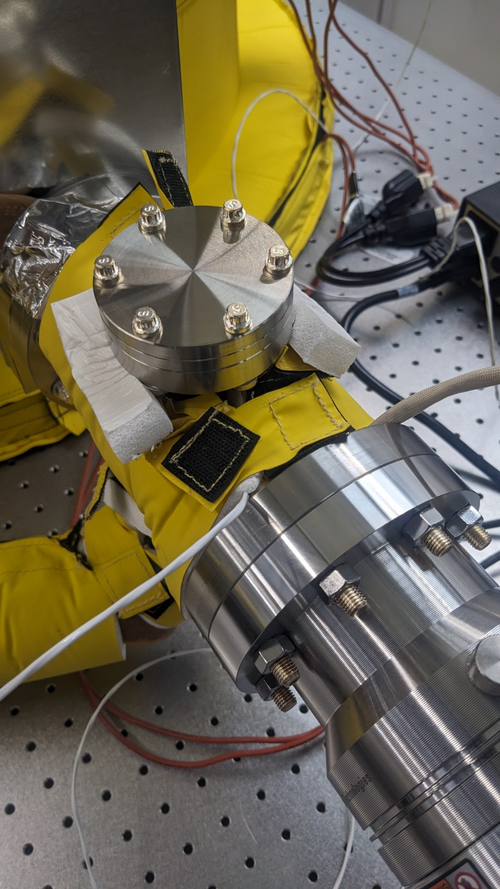
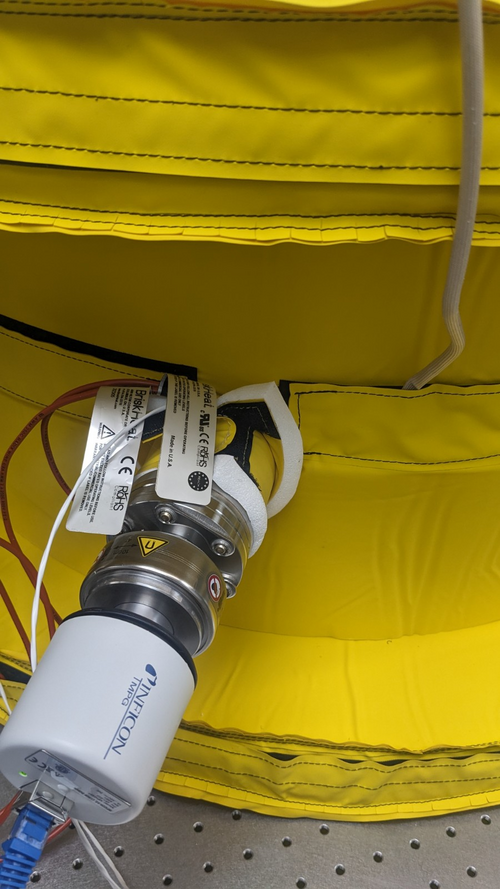
- Install the high temperature controller thermocouples onto the chamber (see images):
- One thermocouple is installed on the other side of the cross before the turbo pump
- One thermocouple is installed on the main volume next to the PID controller RTD
- Attempt to remove electronic box and magnetic shield of full range gauges:
- Electronic box is easily removed with an Allen key
- Magnetic shield cannot be removed since the gap between the vacuum flange and the gauge bolt is too short for a spanner to go in. This is mainly due to the bolt washers are in the way (see images)
- To remove the magnetic shield, the main volume has to be vented and the gauges need to be readjusted.
- Attempt to power heaters (but only heat to 80 deg C):
- Leaving the gauges intact, the high temperature controller + PID controller are turned on to test heating the chamber
- At this point, both of the high temperature controllers are connected to the same power strip (Vacuum chamber end of the table)
- After heating up to 65-70 deg C range, the powers turned off on both controllers + the lights on one end of the table
- Upon inspection, the power strip has turned itself off, I don't know what the model of the power strip but we should check its current limit
- For a quick test, I connect one of the two heater controlling system to the power board on the work desk while leaving the other running off the same power strip: The heaters appeared to be function ok and able to reach 80 deg C, at which point I turned it off and left for the day
21 June 23:
The goals of today was to remove the electronic boxes and magnetic shields on full range gauges to enable high temperature bakeout
- Upon returning to the lab, the gauges readout of vacuum pressures were:
- Gauge 1 (main volume): 3.31E-7
- Gauge 2 (RGA line): 3.40E-7
- Venting the both main volume and RGA line
- Remove the two full range gauges from their flanges
- Electronic boxes and magnetic shields were removed according to the gauge manuals (see images)
-
- Mount the gauges (with only its probing volume) back onto their respective flanges, ensuring that the flange washers do not block access to the magnetic shield screws
- Only remount magnetic shield + electronic box for one gauge (gauge 2: RGA line) for monitoring chamber pressure
- Turn on scroll pump and let the chamber pump down
- Rearrange heater controller connections while waiting for pumping down:
- Controllers for bottom + pump & RGA line heaters remain the same: connected to power strip on vacuum end of the table
- Controllers for lid + upper chamber main volume: connected to power strip on clean&bake end of the table
- Once the pressure readout by gauge 2 reached 3 Torr, the turbo pump was turned on and left to run for 45 minutes
- Upon returning to the lab, pressure on gauge 2 read 5E-6 Torr and was still decreasing
- Disconnect the ethernet cable to gauge 2, remove its electronic box and magnetic shield
- Turn on heater controller units and let them drive the heaters to get up 150 deg C
- At 95 degree range, I could see smoke at some locations, mainly the RGA and pump lines where the insulation do not fit properly and the velcros are likely to be overheated
- Upon reaching 90 degree range (measured by sensors), the powers turned off on both sides of table (including heaters, lights and scroll pump)
- Turn off both heaters controllers and unplug them from power strip. Attempt to switch the power strip back on but nothing happened
- It is now not the power strips problem and must be further down the line from outside the tent, most likely the power supply that these strips connected to: What is the power supply model + current limit?
- The heater controllers left unplugged, I temporarily plugged scroll pump to the desk power strip so it can still run
|
| Attachment 1: Pirani_gauge_blankReplacement.jpg
|
|
| Attachment 2: ThermoCouple1.jpg
|
|
| Attachment 3: ThermoCouple2.jpg
|
|
| Attachment 4: Gauge1_magneticShield_screw.jpg
|
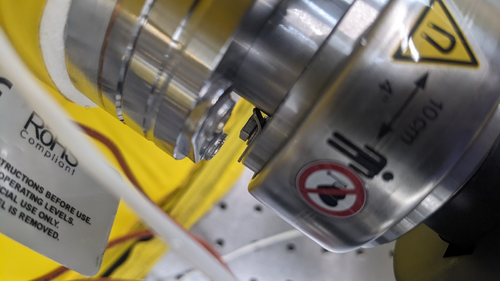
|
| Attachment 5: Gauge2_magneticShield_screw.jpg
|
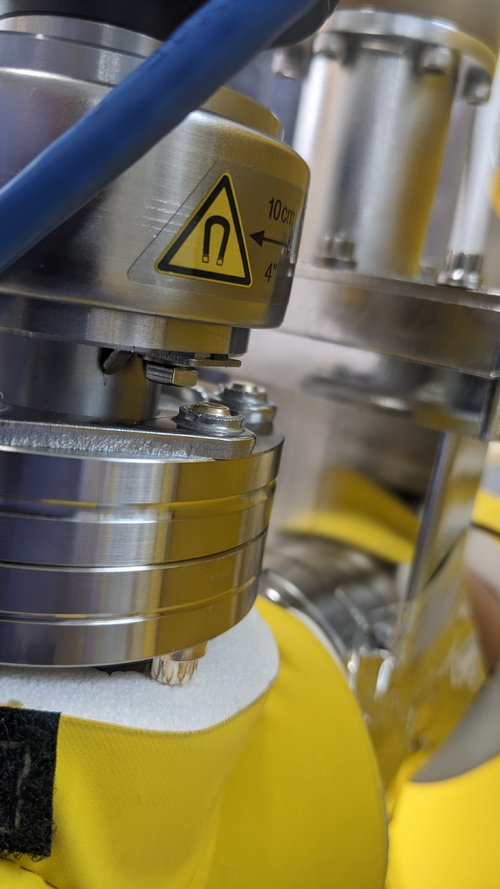
|
| Attachment 6: Fullrange_gauges_components.jpg
|
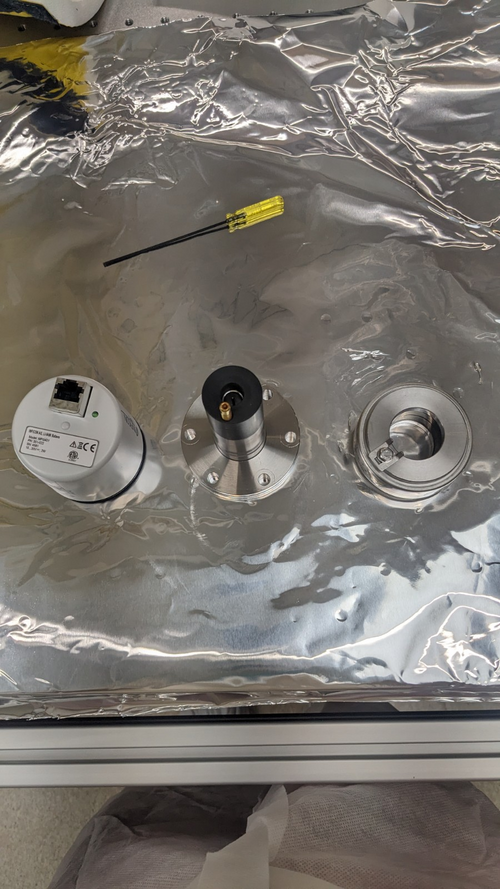
|
|
141
|
Mon Jul 3 14:32:24 2023 |
Cao | Infrastructure | VAC | Cooling down vacuum chamber |
| [Cao]
After leaving the the chamber to bake at 120 deg C from Thursday 3:41 pm. Today I started to cool the chamber down to room temperature at 11:30 am (total bake duration: 91 hours 49 minutes). Ideally, this process should be ramped down slowly, approx. 6 degree per hour. However we had no ramping function with out controller. The only method to tune this cool/ heat rate is to tune the PID parameters, which are:
- Pb : Proportional band, this quantity is inversely proportional to the P-gain
- ti : Integral time. Increasing integral time makes the output response slower to error, thus the opposite effect of increasing integration gain
- td : Differential time
Since the differential term doesn't contribute to rise time significantly, we neglect it for now and first change Pb and ti . The factory default settings :
- Pb : 50
- ti : 100 s
- td : 25 s
Initially Ichanged Pb from 50 to 200 (max) and ti to 999 s (max) but there is a large offset error. Currently, Pb and ti are sitting on the following settings:
- Pb : 200
- ti : 800 s
At this setting it takes 25-30 mins to drop 6 degrees, which is not as slow as we want but we will have to tune our PID more carefully.
At the first stage, I dropped the temperature to 60 deg C. After 3 hours, we dropped the setpoint to 25 degrees and let the vacuum chamber to cool to room temperature. |
|
142
|
Mon Jul 3 16:26:21 2023 |
Cao | Infrastructure | DAQ | Access and control Red Pitaya remotely and run it on local machine |
| [Cao]
To access and control the Red Pitaya using Python locally on a machine within the local network, one should follow these steps:
-
Start the SCPI server. This is achieved by first log onto the Red Piatay page
rp-xxxxxx.local/
- Go to Development >> SCPI server and turn the server on. (Note : The server is currently running)
- Communication with Red Piataya is done through PyVista, install PyVista with:
sudo pip3 install pyvisa pyvisa-py
This has been installed on Chimay. Ensure that you have pip3 install, if not, you can install it using:
sudo apt-install python3 pip
- To start talking to the RedPitaya, ensure you have the scipt
redpitaya_scpi.py in your local folder. This is the standard class that you will import to your code to establish connection with the Red Pitaya. This code can be found in directory ~/RedPiatya or this link
|
|
97
|
Fri May 12 20:28:34 2023 |
Aiden, Cao | Physics | VAC | Vacuum chamber Helium leak test |
[Aiden, Cao]
1. Helium leak test
- 2:00 pm: Uninstall regulator from nitrogen gas tank and move to helium gas tank. Place helium onto cart and move to the rear door of the clean tent. With the tank remaining outside, feed hose through the flexible wall to use in clean tent - See attached image
- 2:25 pm: Start Helium leak test: At each CF connection, He gas is sprayed while its level is monitored with the RGA in leak detection mode. A constant flow of helium is maintained until the level of helium detected by the RGA plateaus out.
- All connections show low helium leak detected (< 3e-11 Amp)
- The connections with highest leak detected are from reducing cross to flex hose and cross to RGA. They are on 2 - 3e-11 Amps. All other connections are less than 8e-12 Amps. We verified tightness of these two connection but they cannot be tighten any further
2. Argon calibrated leak test
After finishing the Helium leak test.
- We opened the Ar calibrated leak. Upon opening the valve to allow Ar to flow through, we can see a surge in pressure measured by the gauges from 6.7e-7 mbar to 1.2e-6 mbar. This is then drop down and stabilised around 8.9e-7 after 5 minutes.
- Upon the the equilibrium is reached, we ran RGA scan twice in Analog mode with the following settings:
- Points Per AMU: 10
- Start Mass : 1
- End Mass : 100
- Focus Voltage: 90 V
- Channel Electron Multiplier (CEM) : On
- CEM Voltage: 1060 V
- Unit: Amps (ion current)
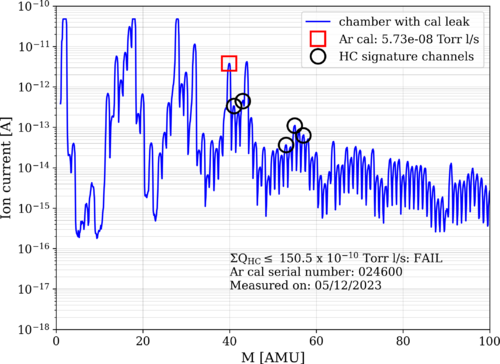
The settings is saved as rga100amu_scan.rga RGA application file in C:/Users/controls/Documents/Vacuum/VacuumChamber/RGA. The data file is saved in Data folder as ArLeak_230512.txt. This file contains the current values for corresponding AMUs. Using this dataset, we can obtain our chamber outgassing rate.
- Using RGA_scan_process.py , which is adapted from Mike Zucker's Matlab code E2000071, and the Ar calibrated leak posted in elog 95 we can compute the outgassing rate to be 150.5E-10 Torr l/s . Our outgassing rate is 37.5 times higher than the required (4.00E-10 Torr L/s per E080177)
- See image attached for the spectrum and the hydrocarbon (HC) tracer masses used to evaluate outgassing
- All codes and data are stored in Vacuum git repo . I'll qrite up an instruction to use the code and post it on our wiki page.
After finishing with Ar cal leak test, we close Ar valve, disconnect and turn off RGA. The He tank is moved back to the wall mount. The chamber is ready for baking installation |
| Attachment 1: PXL_20230512_211717602.jpg
|
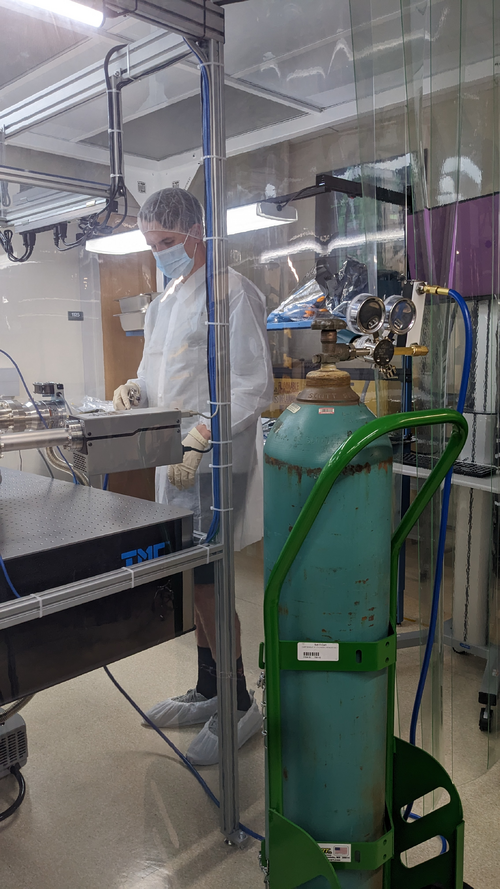
|
| Attachment 2: ArLeak_230512.png
|
|
|
145
|
Wed Jul 5 15:46:47 2023 |
Aiden, Cao | Infrastructure | VAC | Vacuum Chamber Baking Update |
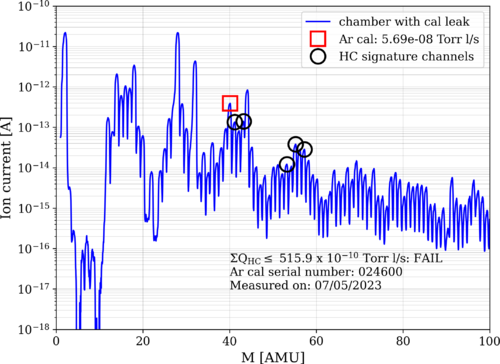
Cao and Aiden put the RGA back on to the chamber and measured the outgassing rate after the chamber has cooled down from its first bake. The figure attached shows the RGA measurements with the Argon leak open.
Also put the Full Range Gauge #2 [RGA line] back onto the system to measure the pressure and got a reading of 2.78 E-7 Torr. We believe it is actually lower as the chamber temp is still at 28 degC rather than the 24 it was previously measured at. The gauge also may have needed more time to equilibrate.
|
| Attachment 1: bake1_230705.png
|
|
|
17
|
Thu Jan 26 18:58:25 2023 |
Aiden | Update | General | Oven Heating |
| Aiden cleaned the oven with methanol again and set the oven to 260 degC for 12 hours. |
|
23
|
Tue Feb 7 17:27:30 2023 |
Aiden | Physics | ELOG | Clean and Bake Batch #1 |
| Cleaned SS parts with liquinox for 20 min. Then put in oven for 5 steps;
1. Ramp, 100 degC, 15 min
2. Const, 100 degC, 30 min
3. Ramp, 200 degC, 30 min
4. Const, 200 degC, 48 hours
5. Ramp, 25 degC, (off)
PS. Ultrasonic washer does not have heating feature. |
|
25
|
Fri Feb 10 15:15:30 2023 |
Aiden | Update | General | Bagging First Batch |
| Aiden Bagged and Tagged the first batch of stainless steel parts shown on the google spread sheet.
1. Removed two parts from the oven.
2. Place them in the ESD bag.
3. Seal bag with Kapton Tape.
4. Create label including part name and number underneath it.
5. Put label onto the side of the bag where it is not sealed with tape.
6. Placed bagged items into clean room on work table.
ps. total bags in first batch = 4 |
|
29
|
Mon Feb 13 18:57:53 2023 |
Aiden | Summary | General | Clean and Bake batch 2 |
| Cleaned second batch of SS parts with liquinox for 20 min. Then put in oven for 5 steps; 1. Ramp, 100 degC, 15 min 2. Const, 100 degC, 30 min 3. Ramp, 200 degC, 30 min 4. Const, 200 degC, 48 hours 5. Ramp, 25 degC, (off). |
|
30
|
Fri Feb 17 19:12:39 2023 |
Aiden | Update | General | Clean and Bake batch 3 |
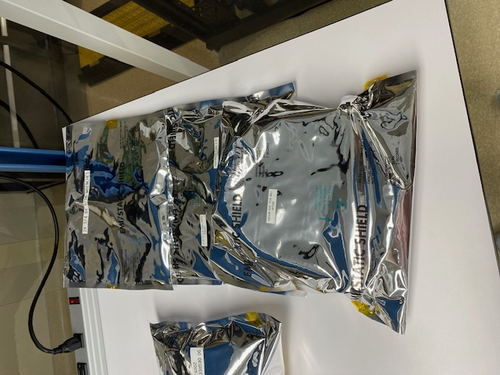
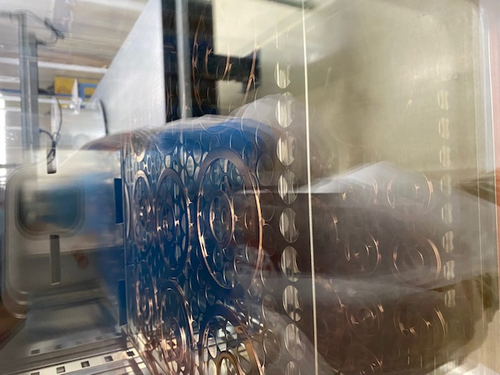
| Bagged and Tagged batch 2 parts by placing no more than two parts per ESD bag then taped them with kapton tape and tagged them with their name and part number. Than placed them inside the clean room on the work bench. Total of 3 Bags used.
For Batch 3- Cleaned all copper gaskets with liquinox for 10 minutes, dried them off with nitrogen, then placed into oven where the are currently undergoing the following steps;
1. Ramp to 100 deg C in 15 minutes.
2. Dwell at 100 degC for 30 minutes.
3. Ramp to 175 degC in 30 minutes.
4. Dwell at 175 degC for 24 hours.
5. Turn off and cool down to room temperature.
To see the specific parts in batches 2 and 3 refer to the clean and bake data sheet. https://docs.google.com/spreadsheets/d/19gnv1q9l64gxnq76KfcXizbqShJfK0ayn2Js1SiAZok/edit?skip_itp2_check=true#gid=1549161924 |
| Attachment 1: IMG_4126.jpg
|
|
| Attachment 2: IMG_4125.jpg
|
|
|
31
|
Tue Feb 21 17:51:04 2023 |
Aiden | Summary | General | Clean and Bake batch 4 |
| Bagged and Tagged batch 3 parts by placing no more than two part numbers per bag and taped them with kapton tape and labeled them with their name and part number. Then placed them in the clean room on the work bench.
Cleaned batch 4 parts with liquinox and placed the into the oven for 5 steps;
1. Ramp to 100 degC in 15 minutes.
2. Dwell at 100 degC for 30 minutes.
3. Ramp to 200 degC in 30 minutes.
4. Dwell at 200 degC for 48 hours.
5. Turn off and cool down to room temperature.
To see the specific parts in batch 4 please refer to the Clean and Bake spread sheet on the Richardson lab page: https://docs.google.com/spreadsheets/d/19gnv1q9l64gxnq76KfcXizbqShJfK0ayn2Js1SiAZok/edit#gid=1765414234 |
| Attachment 1: IMG_4148.jpg
|
|
| Attachment 2: IMG_4147.jpg
|
|
|
38
|
Tue Feb 28 19:37:22 2023 |
Aiden | Summary | General | Clean and Bake batch 5 |
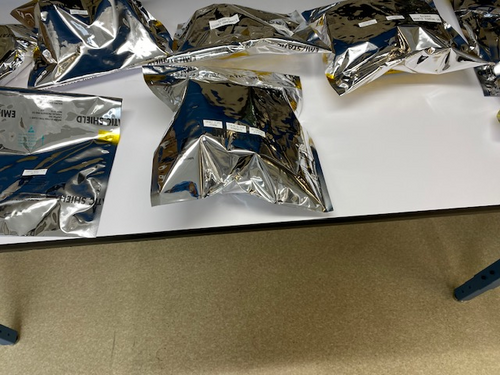
| Bagged and Tagged batch 4 parts by placing no more than two part numbers per bag and taped them with kapton tape and labeled them with their name and part number. Then placed them in the clean room on the work bench. Cleaned batch 5 part (Viton O-Ring) with liquinox and placed the into the oven for 5 steps; 1. Ramp to 100 degC in 15 minutes. 2. Dwell at 100 degC for 30 minutes. 3. Ramp to 180 degC in 30 minutes. 4. Dwell at 180 degC for 48 hours. 5. Turn off and cool down to room temperature. To see the specific parts in batch 5 please refer to the Clean and Bake spread sheet on the Richardson lab page: https://docs.google.com/spreadsheets/d/19gnv1q9l64gxnq76KfcXizbqShJfK0ayn2Js1SiAZok/edit#gid=1765414234
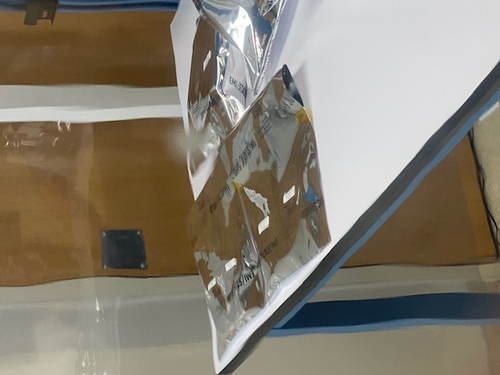
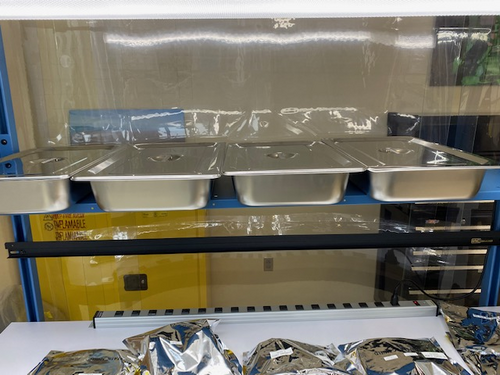
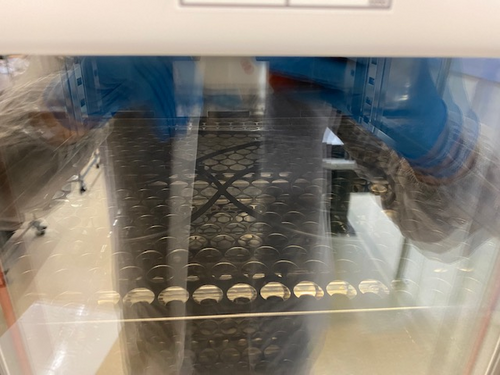
Hand cleaned stainless steel containers and silver coated screws. Designated each container with its contents with the label maker and placed inside the clean room. Should be noted that the fasteners were very clean before the hand cleaning and showed not dirt on the wipes. Added these parts to the clean and bake data base sheet and designated the type of cleaning as "rough cleaning". Gabriella helped with this cleaning and today was her first day in the lab. |
| Attachment 1: IMG_4168.jpg
|
|
| Attachment 2: IMG_4169.jpg
|
|
| Attachment 3: IMG_4170.jpg
|
|
|
42
|
Fri Mar 3 19:13:33 2023 |
Aiden | Summary | General | Clean and Bake Batch 6 |
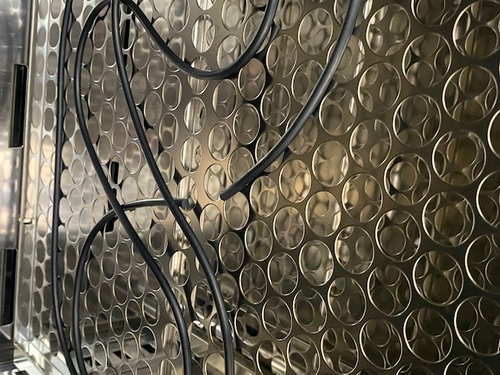
| Started to clean the dirtiest of the valves. I could not finish but I definitely made good progress on it. The MDC valve is very dirty and there are many places I could not reach with my fingers. I used Acetone and IPA for this first round of cleaning on it.
I also was going to bag the viton O-Ring from the previous Batch, however it seems to have broken during the bake and I am leaving it inside the oven for now. |
| Attachment 1: IMG_4173.jpg
|
|
| Attachment 2: IMG_4174.jpg
|
|
|
47
|
Wed Mar 8 19:29:00 2023 |
Aiden | Summary | General | Clean and Bake batch 7 |
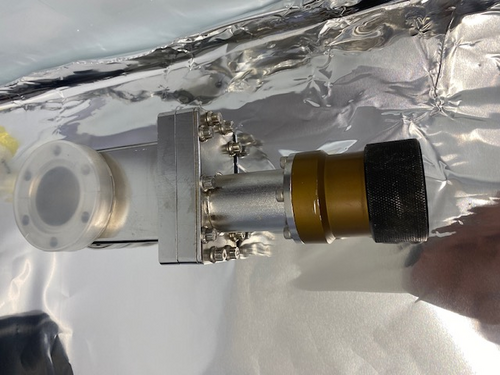
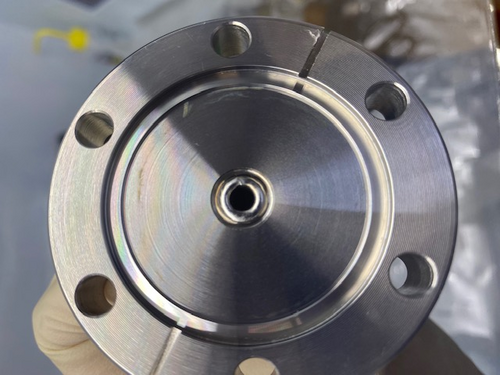
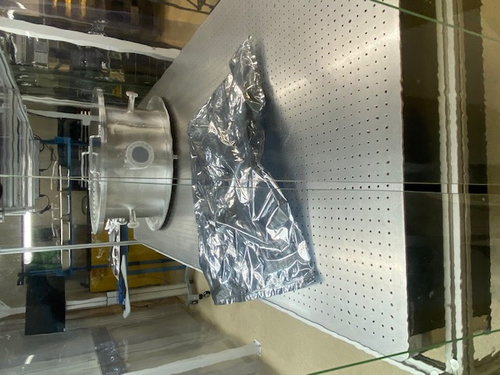
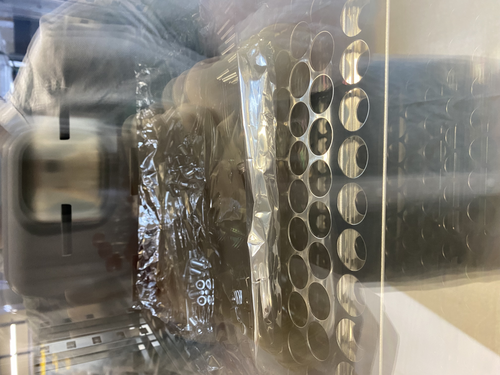
| Today gave another cleaning to the MDC gate valve. It is still very dirty an will need more cleaning. I also cleaned the other 3 valves and the argon leak. These are also in bags inside the clean room. I cleaned them by hand with IPA wipes and had to specifically give the MDC up to air valve a harder clean with acetone as it was not getting clean with the IPA. This valve still has a ring around the face as shown in the first image. Be very cautious when moving the parts in the large ESD bag, it may be heavy and the parts will move inside. |
| Attachment 1: IMG_4180.jpg
|
|
| Attachment 2: IMG_4182.jpg
|
|
|
51
|
Tue Mar 14 18:21:41 2023 |
Aiden | Summary | General | Clean and Bake batch 8 |
| Starting off Peter and I refilled the deionized water barrel.
Then Aiden Cleaned and Bake the FROSTI arms and bases in liquinox for 5 minutes. Then placed them in the oven where they will undergo the following steps;
1. Ramp to 100 degC in 15 min.
2. Dwell at 100 degC for 30 min.
3. Ramp to 120 degC in 30 min.
4. Dwell at 120 degC for 48 hours.
5. OFF
Also cleaned the 2.75 MDC Gate valve for 20 minutes (10 minutes each side) in liquinox. It looks significantly cleaner in areas I could not reach before. However some areas like the flat bottom threaded holes are still very dirty. I also made sure to dry it thoroughly and wrapped it in UHV foil until I further cleaning is decided. |
|
52
|
Fri Mar 17 19:46:39 2023 |
Aiden | Summary | General | Clean and Bake batch 9 |
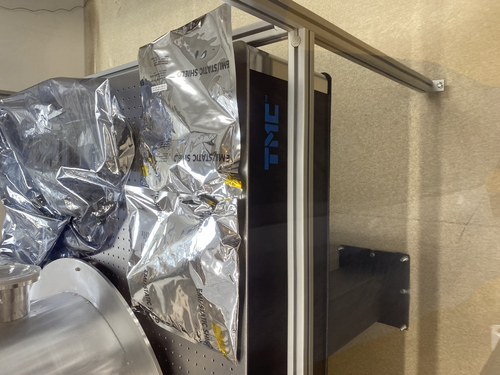
| Bagged and Tagged the reflector arms and bases and placed them inside the clean room. Total of 2 bags used. Cleaned and Baked parts in batch 9 on the spread sheet and used the following procedure;
1. Ramp to 100 degC in 15 min.
2. Dwell at 100 degC for 30 min.
3. Ramp to 200 degC in 30 min.
4. Dwell at 200 degC for 48 hours.
5. OFF
Also soaked the 2.75" CF gate valve in acetone to try and clean the open threads around the part. Then cleaned it in the ultrasonic washer with liquinox for 20 minutes (10 minutes each side). It looks better than it used to but the threads still seem to be the problem and will probably need even further cleaning. |
| Attachment 1: IMG-4208.jpg
|
|
| Attachment 2: IMG-4209.jpg
|
|
|
60
|
Mon Apr 3 17:04:05 2023 |
Aiden | Summary | General | IDP Scroll Pump Assembly |
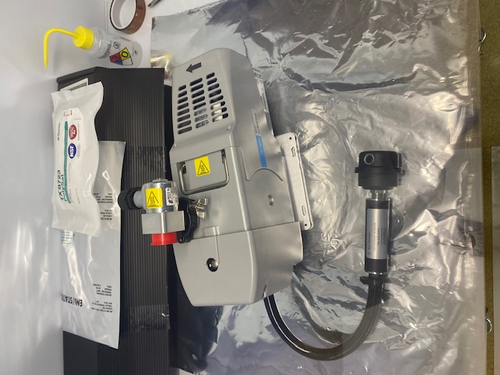
| Aiden installed the isolation valve and the exhaust silencer kits on the IDP-3 Scroll pump. The entire assembly still needs to be wiped down but overall no residue came off when putting on the kits. |
| Attachment 1: IMG_4244.jpg
|
|
|
69
|
Wed Apr 12 10:53:02 2023 |
Aiden | Summary | General | Valve Cleaning |
| Bagged and Tagged the parts from batch 10 and placed them inside the clean room.
Then cleaned the last gate valve in liquinox for 20 minutes (10 minutes each side). Then dried the valve, bagged, tagged, and placed it inside the clean room. |
|
72
|
Mon Apr 17 17:06:49 2023 |
Aiden | Summary | General | Clean and Bake batch 11 |
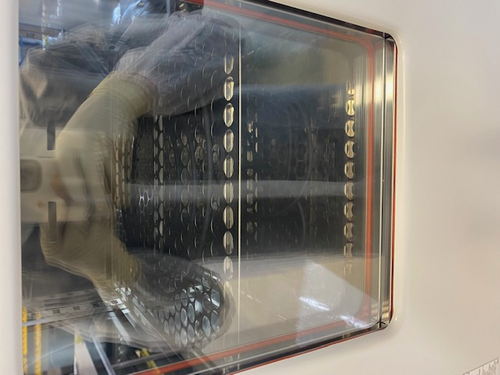
| Cleaned the Viton O-Ring for the main chamber in Liquinox for 10 minutes. Then put it in the oven to back for;
1. Ramp to 100 degC in 15 min.
2. Dwell at 100 degC for 30 min.
3. Ramp to 180 degC in 30 min.
4. Dwell at 180 degC for 24 hours.
5. Off
Note: There were three viton -rings in the bag sent to us. I cleaned and baked 2 of them and left the third in the bag. |
| Attachment 1: IMG_4262.jpg
|
|
|
77
|
Mon Apr 24 17:38:45 2023 |
Aiden | Summary | General | Clean and Bake Batch 12 |
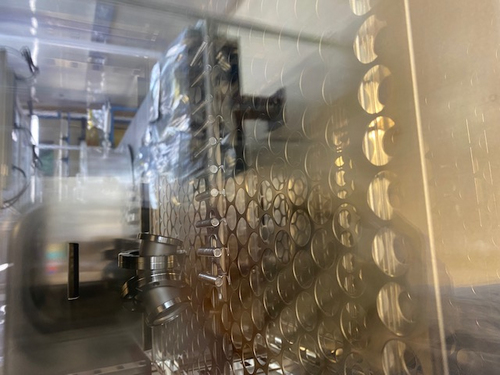
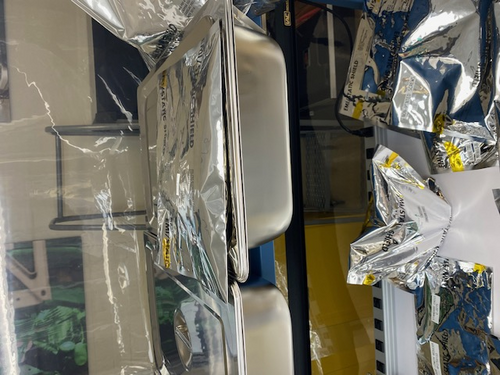
| Today I Bagged and tagged the o-rings from batch 11 and placed them inside the clean room. I also cleaned batch 12 parts in liquinox for 10 minutes and them placed them into the oven where they will undergo the following steps;
1. Ramp to 100 degC in 15 min.
2. Dwell at 100 degC for 30 min.
3. Ramp to 200 deg C in 30 min.
4. Dwell at 200 deg C for 48 hours.
5. Off |
| Attachment 1: IMG_4269.jpg
|
|
| Attachment 2: IMG_4268.jpg
|
|